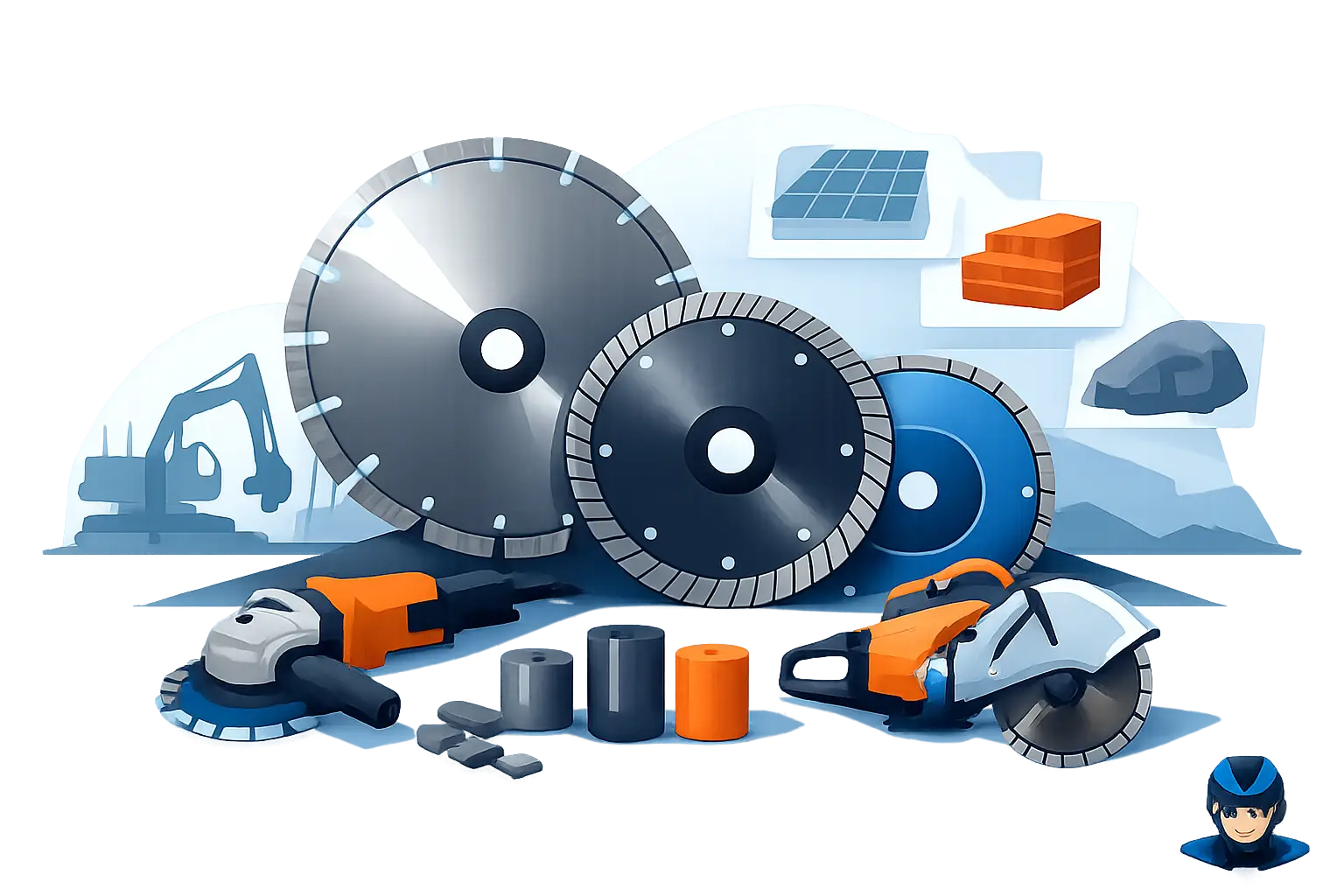
A blade that cuts reinforced concrete cleanly on Monday can glaze over badly on dense porcelain by Tuesday. That is usually not a blade fault. It is a selection fault. A proper diamond blade selection guide starts with the material, the machine, and the cut requirement – not the diameter alone.
For contractors, fabricators, demolition teams and workshop operators, blade choice affects more than cut speed. It changes finish quality, vibration, operator control, machine load and blade life. On busy sites, the wrong blade also creates hidden cost through downtime, edge damage and rework. Getting selection right at the start is a practical decision, not a catalogue exercise.
The first question is simple: what exactly are you cutting? “Concrete” is too broad. Green concrete, cured concrete, heavily reinforced concrete, block, paver, granite, ceramic tile and asphalt all behave differently under the blade. Aggregate hardness, abrasive content and embedded steel change how fast the bond wears and how effectively fresh diamonds are exposed.
This matters because a diamond blade does not cut in the same way as a toothed blade. The exposed diamonds grind the material, while the metal bond holds those diamonds in place until they wear out and release. If the bond is too hard for the application, the blade can become smooth and stop cutting efficiently. If the bond is too soft, the segment wears away too quickly and blade life drops.
That is why selection is usually a balance between cutting speed and service life. On some jobs, faster cutting is the priority because programme time is tight. On others, especially repetitive workshop work, predictable wear and stable output matter more than outright speed.
Material remains the main selection factor. Hard materials generally need a softer bond so the worn diamonds can release and new cutting edges can appear. Softer or more abrasive materials usually need a harder bond to resist rapid segment wear.
For reinforced concrete, the blade must cope with both cured concrete and intermittent steel contact. A general-purpose blade may work for light cutting, but for regular site use on slabs, beams or openings, a blade designed for reinforced concrete is the safer choice. It will usually offer a bond and segment design that stays productive when crossing rebar rather than slowing sharply or overheating.
Asphalt is different again. It is highly abrasive and often cut in conditions that generate heat and slurry. A blade that performs well on concrete can disappear quickly in asphalt because the bond is not hard enough for the abrasion rate.
Tiles, porcelain and other brittle finish materials bring a different requirement – edge quality. Here, chip control can matter more than maximum feed speed. A turbo or continuous rim option is often more suitable than an aggressive segmented blade, but the exact choice depends on material hardness, glaze type and finish standard.
Natural stone sits in the middle of several variables. Granite, engineered stone and other dense products demand stable cutting and good heat control. Softer stone may cut freely, but that does not automatically mean any blade will do the job well. Surface quality, break-out risk and machine compatibility still need checking.
The same blade category can behave differently depending on the machine. That is why blade diameter and bore size are only the starting points.
Hand-held cut-off saws, floor saws, masonry saws, table saws and angle grinders each impose different operating conditions. Power output, spindle speed, feed pressure, cut depth and cooling method all affect performance. A blade that is excellent on a high-power floor saw may feel slow or unstable on a smaller hand-held machine.
Wet and dry cutting is another key distinction. Wet cutting helps cool the blade, suppress dust and flush debris from the cut. It is often the preferred option for heavier cutting and finish-sensitive materials. Dry cutting is useful where water management is impractical, but it places more thermal stress on the blade and machine. The blade must be designed for that duty cycle, and the operator needs to allow proper cooling intervals where required.
Maximum operating speed must also match the machine. This is a safety issue first, but it also affects cut quality. A mismatch between blade specification and machine speed can lead to poor tracking, excess wear or unsafe operation.
Segment style is where many buyers look first, but it only makes sense after material and machine have been defined.
Segmented blades are common for concrete, masonry and general construction cutting because they clear debris well and cut aggressively. They are a practical choice where productivity matters more than achieving a polished edge.
Turbo blades offer a more continuous cutting action with improved edge quality while still maintaining reasonable speed. They are often selected when the material is dense but the finish cannot be overly rough.
Continuous rim blades are normally used where the cleanest edge is required, especially on tile and brittle finishes. The trade-off is that feed rate is usually lower, and the blade must be matched carefully to both material and machine to avoid overheating.
Segment height and segment width matter too. Taller segments can provide longer service life, but that does not guarantee better performance if the bond is wrong for the application. Wider segments may improve durability in some heavy-duty cuts, though they also increase cutting resistance. On lower-powered machines, that can reduce efficiency rather than improve it.
Many blade problems come from jobsite variables rather than manufacturing defects. Feed pressure is a common example. If operators force the blade through the cut, heat rises quickly and segment damage becomes more likely. If the blade is underfed on hard material, glazing can occur because the diamonds are not working hard enough to expose fresh grit.
Cut depth also changes blade behaviour. Deep passes in dense concrete place far more stress on the segment and core than shallow scoring cuts. Where possible, staged cutting can improve control and reduce thermal load.
Material condition is another overlooked factor. Fresh concrete cuts differently from old, fully cured concrete. Concrete with hard aggregate behaves differently from low-strength block. Even within one project, slab sections can vary enough to affect output.
There is also the issue of steel content. A blade selected for plain concrete may still cut reinforced sections, but not efficiently or consistently. If the job includes regular contact with rebar, dowel bars or mesh, choose for that condition from the start.
A general-purpose blade has a place, especially for contractors handling mixed materials in light to moderate volumes. It reduces the need to carry multiple blade types and can be practical for service work, snagging and varied site tasks.
The limitation is predictability. A general-purpose blade is built to cope across several materials, not to lead in one specific application. On repetitive cutting, specialist blades usually deliver better life, cleaner cuts or faster production. For trade users running regular concrete, asphalt, tile or stone work, application-specific selection is usually the better operational decision.
If the blade cuts slowly from the beginning, wanders in the cut, overheats, loses segments early or leaves unacceptable edge damage, the issue may be selection rather than handling. Glazing is a common sign that the bond is too hard for the material. Excessively rapid wear points in the opposite direction.
Uneven segment wear can indicate machine condition problems, poor mounting, unsuitable operating speed or unstable cutting technique. It is not always a blade issue in isolation. This is why technical support and real application guidance matter when specifying blades for demanding work.
Start with five points: material, machine, wet or dry method, cut quality requirement, and expected volume. Once those are clear, selection becomes narrower and more accurate.
If the material is known and repetitive, choose a blade built specifically for that application. If the material mix is uncertain but the work is occasional, a quality general-purpose blade may be enough. If finish is critical, prioritise rim type and chip control. If production speed is critical, focus on bond suitability, segment design and machine compatibility.
For professional users, the best choice is rarely the broadest specification on paper. It is the blade that matches real working conditions and stays consistent across the job. That is the difference between buying a consumable and selecting a cutting solution.
A good blade should feel predictable – steady entry, controlled tracking, acceptable speed and wear that makes sense for the material. If the match is right, the machine works easier, the operator works cleaner, and the job keeps moving. When selection is treated as part of the cutting process rather than an afterthought, results improve where it matters most: on site, on schedule and in the cut itself.
Choose the wrong diameter on site and the problem shows up fast – loose pipe penetrations, oversized openings, slow drilling, or a core rig working harder than it should. Diamond core drill bit sizes are not just catalogue numbers. They affect fit, productivity, machine load, finish quality, and whether the drilled hole actually matches the installation requirement.
For contractors, coring specialists, and procurement teams, size selection usually starts with the finished opening. But that is only one part of the decision. The bit diameter, barrel length, segment specification, and the material being drilled all work together. A 52 mm bit in reinforced concrete does not behave the same way as a 52 mm bit in blockwork, and a deep hole requirement can change the best choice even when the diameter stays the same.
In most professional ranges, diamond core drill bit sizes are stated by outside diameter. That means the nominal size refers to the external width of the barrel, not always the exact finished internal hole after wear, runout, or application variables. On a clean, stable setup, the drilled hole will generally track closely to the bit size, but there can be slight variation depending on machine condition, feed pressure, aggregate hardness, and reinforcement content.
This matters when the opening has to accommodate sleeves, conduit, pipework, anchors, or ducting. If the installation needs clearance, the selected bit often has to be larger than the nominal service diameter. If the fit needs to be tighter, tolerance becomes more critical and machine stability matters even more.
Bit size is also only one dimension. Professional users should check working length and overall barrel length, particularly for thick slabs, beams, retaining walls, and staged coring work. A correct diameter with insufficient drilling depth is still the wrong bit.
Smaller diameters are typically used for anchor points, cable routes, and light service penetrations. Mid-range sizes are common for plumbing, electrical and M&E work, while larger diameters are more typical in infrastructure, drainage, ventilation, and specialist openings.
In practical terms, users will often work within size bands rather than isolated numbers. Around 25 mm to 52 mm is common for lighter service work and fixings. Sizes from roughly 65 mm to 127 mm are frequently selected for pipe penetrations, conduits and general building services. Once the diameter moves beyond that, applications tend to become more structural or service-heavy, such as drainage lines, larger sleeves, duct penetrations, or controlled demolition access.
There is no universal best-selling size across every site because application drives the choice. A mechanical contractor may repeatedly use a narrow range for service runs, while a concrete coring team handling mixed commercial and infrastructure work will need far broader coverage.
Smaller core bits are often chosen when the job calls for speed, accuracy and minimal breakout. Typical uses include anchor installations, electrical drops and smaller conduit routes. On these diameters, machine control is especially important because any vibration or misalignment is proportionally more noticeable in the finished hole.
These sizes also place different demands on the operator than larger barrels. They can feel easier to handle, but they are not automatically more forgiving, particularly in dense reinforced concrete.
This is where much of the daily site demand sits. Penetrations for plumbing lines, sleeves, electrical services and HVAC work often fall into this range. The reason is straightforward – these diameters suit the majority of practical service openings in commercial and residential construction.
For this category, the required clearance needs careful checking before drilling begins. A bit selected too close to the service diameter may create installation problems later, especially where insulation, grommets or sleeve tolerances are involved.
Larger diameters increase torque demand, require a more stable setup, and expose any weakness in the core rig or stand. They are often used in demanding concrete sections where reinforcement, depth and access all complicate the cut.
At these sizes, drilling speed depends heavily on matching the bit to the machine and the material. A high-quality barrel with the wrong segment bond for the concrete can underperform even if the nominal diameter is correct.
The most reliable starting point is the finished service requirement, not the bit rack. If a pipe, sleeve or duct has a fixed outside diameter, work backwards from the clearance needed for installation and sealing. That approach reduces rework and avoids drilling a neat hole that is technically unusable.
Material also changes the decision. In plain concrete, a selected size may perform efficiently with a broad range of specifications. In heavily reinforced concrete, the same diameter may need a more suitable segment design and a machine with better torque control. In masonry or block, speed may be less of a problem than edge stability or breakout.
Access conditions matter as well. Hand-held coring, rig-mounted drilling, inverted drilling and confined spaces all place different limits on usable diameters. On paper, several sizes may suit the opening. On site, only one may suit the setup.
Buyers sometimes focus on diameter and overlook wall thickness, segment height and barrel construction. That is where two bits with the same nominal size can behave very differently.
A heavier barrel can offer better stability and durability in demanding reinforced concrete, but it may also increase overall load. A thinner wall can improve speed and reduce friction in some applications, though durability and segment support have to be considered. Segment height affects usable life, but a taller segment is not automatically better if the bond is wrong for the material.
The connection system must also match the machine. Thread type and compatibility are basic checks, but they are critical. Mismatched equipment wastes time and introduces avoidable risk.
As diameter increases, the machine has to deliver enough torque and stability to keep the cut consistent. This is where application discipline matters. A core bit size that is technically available may still be impractical on a lighter rig or less powerful motor.
Smaller and medium diameters may be manageable on compact setups, especially in lighter materials. Larger bits usually demand a rig-mounted system, controlled feed and proper anchoring. Trying to push a large-diameter bit beyond the machine’s intended operating range can shorten bit life, slow drilling and produce poor hole quality.
For trade buyers managing fleets, this is an operational issue rather than just a tooling issue. Standardising around practical size ranges that match the available machines often improves productivity more than simply expanding the bit inventory.
Most day-to-day work can be covered by standard diameters, but some projects require non-standard sizing. This is common when drilling for specialised sleeves, industrial services, retrofit penetrations, or legacy dimensions that do not align neatly with common metric ranges.
Where non-standard sizes are needed, specification discipline becomes more important. The intended material, depth, machine type and frequency of use should all be clear before the bit is selected. A special diameter that is only judged by the hole size can become an expensive compromise in the field if the rest of the build is not right.
For professional contractors, this is where working with a technical supplier adds value. COOLMAN supports product selection around actual application conditions rather than treating the bit diameter as the whole answer.
The most common mistake is selecting the bit to match the pipe or conduit exactly, with no allowance for tolerance or installation clearance. The second is treating all concrete as the same. Aggregate hardness, reinforcement density and curing condition can all change the way a given size performs.
Another frequent issue is overlooking drilling depth. A standard barrel may suit the diameter but not the wall thickness, forcing extensions or staged work that should have been planned earlier. Finally, many avoidable problems come from pushing a diameter beyond what the machine or setup can properly support.
On busy sites, the right choice is usually the one that balances fit, drilling speed, tool life and equipment capacity. That balance is rarely found by diameter alone.
If the hole matters, the size needs to be chosen as part of the full drilling setup. Get that right at the start, and the rest of the job tends to move with fewer delays, cleaner results and less strain on both operator and equipment.
If you are comparing concrete coring machine price across suppliers, the fastest way to waste budget is to look at the machine alone. On site, price is tied to drilling diameter, depth, reinforcement density, mounting method, duty cycle and how often the system will be pushed beyond light service work. A low entry cost can become expensive very quickly if output drops, bits wear early or the rig cannot hold alignment under load.
Professional buyers usually do not ask one question. They ask three at the same time: what machine is suitable, what configuration is required, and what level of performance is needed for the actual job. That is the practical way to assess value in coring equipment.
The biggest factor is machine class. Hand-held units for smaller diameter work sit in a different category from rig-mounted systems intended for larger holes, repeated drilling and reinforced concrete. Once drilling diameter increases, torque, motor stability and stand rigidity matter more, and the equipment specification moves up accordingly.
Motor type also changes the pricing level. Electric core drills are common for building services, retrofit work and indoor applications where controlled operation is required. Hydraulic systems are used in more specialised conditions where high output or specific site constraints apply. The machine itself is only part of the equation – the power source, compatibility and application suitability all affect the final investment.
Build quality is another major cost driver. A machine designed for occasional use may complete simple openings without issue, but trade users generally need more than basic operation. They need gear durability, reliable feed control, stable anchoring, overload protection and consistent drilling through reinforced sections. Better engineering tends to carry a higher purchase price, but it also tends to reduce stoppages and improve hole quality.
On paper, two machines can look close. Both may be rated for similar diameters, both may appear suitable for concrete, and both may be marketed for professional use. The difference usually shows up under load.
A lower-grade system may slow down badly when it meets dense aggregate or steel reinforcement. That affects drilling speed, bit life and operator control. If the stand flexes, the bit can wander. If the motor struggles, segment wear increases. If the feed mechanism is rough, the hole finish suffers and productivity falls.
For contractors and procurement teams, this matters more than ticket price. The real cost of coring equipment includes labour time, consumable consumption, rework risk and downtime. On repetitive service penetrations, MEP installations, bridge work or industrial maintenance, small losses per hole become significant over a project programme.
A more useful approach is to think in terms of application rather than only machine size. Light-duty work such as small penetrations for plumbing or electrical routes does not require the same setup as repeated large-diameter drilling in structural concrete. The machine should match the workload, not just the hole diameter listed on a brochure.
For lighter internal works, users often prioritise mobility, quick setup and clean operation. In these cases, a compact electric system may be appropriate. Price is influenced by whether the unit is hand-held or supplied with a stand, the maximum bit size it can realistically drive, and the control features included for safe operation.
Where coring is part of daily site activity, the requirement changes. Buyers generally look for stronger motors, more stable rigs and better endurance. Here, concrete coring machine price tends to reflect reliability over long operating hours rather than basic entry-level capability. A machine that holds accuracy and keeps output steady across repeated holes will normally justify a higher spend.
Larger openings, deeper coring and heavily reinforced concrete place far greater demand on the system. The stand, carriage, feed assembly and motor all need to work as a complete drilling platform. At this level, pricing is tied to engineering strength, drilling range, anchoring options and operational control. This is where under-specifying the machine usually becomes expensive very quickly.
Buyers sometimes compare machine prices without accounting for the full coring system. That creates a distorted view of cost.
Core bits are an obvious factor. Bit diameter, segment quality, application suitability and expected wear rate all affect ongoing spend. A machine matched to the wrong bit specification will not perform well, even if both are technically compatible. Reinforced concrete, abrasive material and wet drilling conditions all influence consumable choice.
Then there is the stand and mounting method. Vacuum bases, anchor fixing and rig accessories each have practical implications. If your work regularly moves between floor, wall and angled drilling, the support setup matters as much as the motor. A cheaper machine can become inefficient if the rig arrangement slows installation or limits access.
Water management, slurry control and electrical protection also belong in the discussion. Professional coring is not only about making the hole. It is about keeping the operation controlled, safe and repeatable. Equipment that supports cleaner working and easier recovery can improve site efficiency even if it raises the initial package cost.
When reviewing concrete coring machine price, compare specification against the actual work profile. Maximum diameter is not enough on its own. Check the diameter range the machine handles efficiently, not just theoretically. Look at motor output, gear ratios, stand rigidity, feed smoothness and whether the system is intended for continuous trade use.
Pay attention to serviceability. Machines in regular use need maintenance, inspection and parts support. A technically strong machine backed by proper product knowledge is often a safer procurement choice than a lower-cost option with unclear support. This is especially relevant for contractors running multiple crews or workshop teams trying to minimise downtime.
Operator usability should not be treated as a minor point. A well-balanced motor, clear controls and stable setup can reduce fatigue and improve consistency. Over a long shift, that matters. It also matters when less experienced operators are using the equipment under supervision and need predictable machine behaviour.
Not all coring systems are built to the same standard, even when they sit in a similar category. Established professional product lines tend to focus on repeatability, drilling stability and durability under demanding use. Entry-level units may still have a place, but only if the workload genuinely matches their design limits.
For trade supply, this is where product selection becomes technical rather than promotional. A supplier that understands drilling applications can help separate occasional-use equipment from machines built for heavy site cycles. That is often where buyers avoid costly mismatches.
COOLMAN Malaysia Sdn Bhd operates in this specialist category, where machine choice is linked closely to application, bit selection and project conditions rather than a single advertised number.
A higher-priced machine is easier to justify when the work involves frequent reinforced concrete, larger diameters, deeper cores or repeated drilling across multiple sites. It also makes sense when labour cost is high enough that faster, more stable drilling quickly offsets the extra capital spend.
The same applies when accuracy matters. Service penetrations through slabs and walls often need to align with downstream installations. If poor stability causes deviation, the cost of correction can exceed the saving made on the machine. Better control is not a luxury in those cases – it is part of doing the work properly.
There are also situations where a lower-cost machine is perfectly reasonable. Short-run jobs, smaller hole sizes and occasional use do not always require a heavy-duty system. The point is not that every buyer needs the top tier. The point is that concrete coring machine price only makes sense when read against the drilling duty, site conditions and expected service life.
A sensible buying decision starts with the holes you need to drill next month, not just the machine you want to own today. Match the equipment to the workload, and the price usually becomes much easier to judge.
Anyone who has cut reinforced concrete on site knows the problem starts the moment the blade stops seeing only aggregate. A diamond blade for cutting rebar concrete has to deal with two very different materials in the same pass – abrasive concrete and dense steel reinforcement. If the blade is wrong for the application, cut speed drops quickly, segment wear becomes uneven, and the operator ends up forcing the saw instead of letting the blade work.
For contractors, demolition teams and concrete cutting specialists, this is not a minor consumable choice. Blade selection affects production rate, motor load, finish quality and downtime. On heavily reinforced slabs, beams, columns and precast sections, the right specification is the difference between consistent output and repeated blade changes.
Reinforced concrete is a mixed cutting environment. The concrete itself may range from green to fully cured, from standard structural grade to high-strength mixes with hard aggregate. Then the blade meets steel bar, mesh or bundled reinforcement. Each material wears the segment in a different way.
Concrete tends to abrade the bond and expose new diamonds. Steel does almost the opposite. It generates heat and can glaze the segment if the bond and diamond concentration are not designed for intermittent metal contact. This is why a blade that performs well on plain concrete may slow down badly once reinforcement density increases.
The challenge becomes more pronounced with older structures, bridge elements, industrial floors and heavily reinforced civil works. In these conditions, the blade needs balanced performance rather than being tuned only for speed in one material.
The first point is application matching. Not every diamond blade marketed for concrete is suitable for reinforced concrete, and not every reinforced concrete blade is equally effective across wall saws, floor saws and hand-held cutters. Machine power, RPM, feed pressure and cooling method all influence blade behaviour.
A true reinforced concrete blade is usually built around a bond that can survive steel contact without glazing while still releasing diamond at the right rate in the concrete matrix. Segment shape also matters. Narrow gullets and aggressive segment patterns may cut quickly in some materials, but they can become less stable in long continuous cuts through dense reinforcement.
Blade diameter should match the machine and required depth of cut, but segment height and core strength deserve equal attention. Deep cuts into structural concrete place more stress on the blade body, particularly when the operator encounters multiple bars in one line. A stronger core helps reduce wandering and vibration.
For professional users, it is worth checking whether the blade is intended for wet cutting, dry cutting or both. In most heavy reinforced concrete work, wet cutting gives better cooling, better dust control and more stable segment wear. Dry cutting still has a place, especially in restricted site conditions, but the blade must be designed for that heat cycle and the operator has to respect intermittent cutting practice.
There is no universal best bond. A softer bond exposes fresh diamonds faster and can perform well in hard, dense concrete. A harder bond generally lasts longer in abrasive material, but if it is too hard for the job it may glaze when it hits steel. Reinforced concrete blades are designed to manage this trade-off rather than eliminate it.
On a heavily reinforced beam with dense aggregate, the wrong bond can fail in either direction. Too soft, and segment wear becomes excessive before the cut is complete. Too hard, and the blade polishes over, slows down and starts generating unnecessary heat.
Segment width, height and shape control how the blade enters the cut, evacuates slurry and maintains direction. Turbo-style geometries can improve cutting response in some hand-held applications, while more conventional segmented designs often provide better stability on larger saws. For long floor sawing or wall sawing runs, straight and consistent tracking is usually more valuable than aggressive first-contact speed.
High-grade synthetic diamonds are not only about lifespan. They influence consistency from the first cut to the last. Better diamond distribution and retention typically give smoother feed, less chatter and more predictable wear. In trade use, that predictability matters because it helps site teams plan output rather than react to premature blade failure.
For cut-off saws and smaller hand-held machines, the blade needs fast response, manageable vibration and enough durability to handle intermittent reinforcement contact. Dry cutting capability may be necessary on certain refurbishment or access-restricted jobs, but dust management and duty cycle need close control.
Floor saws place greater demand on straight tracking and core stability. On warehouse slabs, road repairs and suspended slab openings, reinforced concrete blades for floor saws must remain stable through long runs where the blade repeatedly crosses mesh or bar. Here, machine horsepower and shaft condition have a direct impact on blade performance.
Wall sawing in reinforced concrete is a more controlled process, but also more demanding in terms of blade specification. Deep penetration, sustained load and frequent steel contact call for professional-grade segments and a blade body built for precision. In these cases, buying on nominal size alone is a common mistake.
Early blade wear is not always a manufacturing problem. In practice, most failures come from mismatch between blade, machine and material, or from poor cutting technique.
If an operator forces the feed rate once the blade meets steel, segment edges can round off and heat rises sharply. If the saw arbor is worn, the blade may wobble and wear unevenly. If water flow is insufficient, the bond overheats and the segment can lose cutting efficiency long before its usable life is reached.
Glazing is another frequent issue. The blade appears intact, but cutting slows because the bond is no longer exposing fresh diamonds. This often happens when a blade meant for more abrasive material is used on dense reinforced concrete with repeated steel contact. Dressing may restore some performance, but it does not fix the original mismatch.
A good reinforced concrete blade still needs correct use. Start with proper machine setup. Check flange condition, shaft play, belt tension where relevant, and water delivery before the first cut. A high-quality blade cannot compensate for a machine that is running out of true.
During the cut, keep feed pressure consistent. Let the segment work at its designed rate rather than pushing to recover time. When the blade enters steel, a controlled feed generally produces better progress than aggressive forcing. The cut may sound slower for a moment, but overall productivity is better because the blade stays open and cooler.
Depth strategy also matters. On deep cuts, staged passes often protect both the machine and blade better than one heavy push, especially on hand-held equipment. On larger saws, stable setup and correct travel speed achieve the same goal.
A suitable blade for reinforced concrete should give steady cutting speed across mixed material rather than quick concrete cutting followed by a sharp slowdown at the steel. Wear should be even around the circumference. The segment should remain open, and the operator should not need excessive feed force to maintain progress.
You should also see cleaner machine behaviour – less vibration, less motor strain and fewer corrections to keep the cut on line. In production work, that stability is often a better indicator than headline blade life alone.
If the job involves unknown concrete strength, heavy bar density, precast elements, bridge repairs or repeated deep cuts, specification support is worth getting before work starts. A product-led supplier with field experience can narrow the blade choice based on machine type, material condition and expected cut volume. That is usually more efficient than trialling multiple blades on live work.
For specialist users, this is where a technical supply partner adds value. COOLMAN, for example, positions blade selection around actual site application rather than catalogue description alone, which is the practical approach reinforced concrete work demands.
A diamond blade for cutting rebar concrete should be chosen as part of the cutting system, not as an isolated accessory. Get the bond, segment design and machine match right, and the result is not only a faster cut but a more controlled job from the first metre to the last.
A blade that cuts fast on Monday can feel slow and noisy by Thursday if it is matched badly, run incorrectly, or pushed through the wrong material. That is why contractors regularly ask how long do diamond blades last. The honest answer is not a fixed number of hours or metres. Blade life depends on bond, segment design, material hardness, machine setup, cooling, and operator technique.
For professional users, that matters because blade life is not just about replacement intervals. It affects cutting speed, finish quality, machine load, labour time, and overall job efficiency. A blade that lasts longer but cuts slowly is not always the better blade. Equally, a blade that cuts aggressively but wears too quickly may raise cost per cut on demanding work.
In site conditions, diamond blade life can range from a few hours of heavy cutting to many days or even weeks of intermittent use. There is no universal lifespan because diamond blades do not wear in a simple, linear way. They are consumables engineered to expose fresh diamonds as the bond matrix wears away. If that wear rate matches the application, the blade cuts consistently. If it does not, performance drops quickly.
A well-matched blade used on the correct machine can deliver long service on reinforced concrete, asphalt, masonry, tile, stone, metal, aluminium, or other specialist materials. A poorly matched blade can glaze, lose segments, cut off-line, or burn out long before the diamond content is actually exhausted.
This is why experienced buyers do not ask only how long a blade lasts. They also ask how it wears, how it cuts through the target material, and whether it maintains speed under load.
The material has the biggest influence on blade wear. Hard materials such as cured concrete, porcelain, granite, and dense engineering products can polish the bond and reduce cutting speed if the blade is too hard. Abrasive materials such as asphalt, green concrete, sandstone, and some block products wear the bond faster and can consume segments quickly if the blade is too soft.
Reinforcement changes the picture again. A blade cutting heavily reinforced concrete deals with both abrasive aggregate and steel impact. That puts more stress on the segments and core, especially when feed pressure is inconsistent.
Bond selection is central to service life. A hard bond is designed for abrasive materials so the segments do not wear away too quickly. A soft bond is designed for hard materials so fresh diamonds are exposed more easily. If the bond is wrong, blade life and cutting speed both suffer.
This is where many service issues begin. Users often assume a harder bond always means longer life. In practice, a hard bond in very hard material can glaze over and stop cutting properly. The blade may still look usable, but productivity drops and heat rises.
Wet cutting generally improves blade life because water reduces heat, flushes slurry, and helps stabilise the cut. Dry cutting is sometimes necessary on site or in certain access conditions, but it places greater thermal stress on the blade. That means the operator must allow suitable cooling cycles and avoid sustained overloading.
For prolonged cutting in concrete, masonry, stone, or road applications, proper water delivery is not a small detail. It is part of blade protection.
Even a premium blade will wear badly on a machine with incorrect shaft speed, misalignment, worn flanges, unstable feed, or poor power delivery. Arbor fit, blade diameter, operating rpm, and cutting depth all need to match the blade specification.
Vibration is especially damaging. It can accelerate segment wear, cause uneven cutting, and increase the risk of segment loss. If a blade is wearing unevenly, the issue is not always the blade itself.
Forcing the cut shortens blade life. So does twisting in the kerf, starting aggressively, or using the blade to grind sideways. Diamond blades are designed for straight cutting with controlled feed pressure. Letting the blade work at the correct speed usually gives better life than pushing for short-term progress.
A worn blade does not always fail suddenly. More often, it gives clear performance warnings first. Cutting speed slows, the operator needs more pressure to maintain progress, and the blade may produce more heat, noise, or vibration. Cut quality can also deteriorate, with more chipping, wandering, or rough kerf edges.
Segment height is the simplest visual guide. As the segment wears down, the usable diamond layer reduces. Once the segments approach minimum safe height, the blade should be replaced. Continued use beyond that point risks poor performance and potential safety issues.
However, low performance does not always mean the blade is finished. A glazed blade may still have usable segment life if it is dressed correctly and returned to a suitable application.
Using a general-purpose blade where a material-specific blade is needed is a common cause of short life. General-purpose products have their place, especially where materials vary across one project, but specialist applications usually reward a more precise blade selection.
Glazing happens when the bond does not wear fast enough to expose fresh diamonds. The blade looks intact but stops cutting efficiently. This is common when a blade with too hard a bond is used on dense, hard material. Dressing the blade on a suitable abrasive material can often restore cutting action.
Heat damages performance. It can weaken segment retention, distort the core, and accelerate wear. Dry cutting without pauses, inadequate water flow, or excessive feed pressure all raise temperature quickly.
Blades that are dropped, stacked carelessly, or stored in poor conditions can develop core distortion or edge damage before they ever reach the machine. On busy sites and in workshops, basic handling discipline protects both performance and safety.
Start with the correct blade for the material, machine, and cutting method. That sounds obvious, but it is the most reliable way to improve both life and productivity. If the work involves mixed materials, choose the blade around the dominant substrate and the most demanding cutting condition, not the easiest one.
Keep the machine in proper operating condition. Check shaft compatibility, flange cleanliness, belt condition where relevant, and water supply. A blade running true will normally cut cooler and wear more evenly.
Use steady feed pressure instead of forcing the blade. If cutting speed falls suddenly, stop and inspect the situation rather than pushing harder. The issue may be glazing, insufficient coolant, excessive depth of cut, or reinforcement that calls for a different blade specification.
For dry applications, follow sensible cutting intervals so the blade can shed heat. For wet applications, make sure water reaches both sides of the blade consistently. Intermittent water flow is not much better than none at all.
If a blade starts glazing, dress it before performance collapses completely. This can expose new diamonds and recover cutting speed. It is a practical maintenance step, not a last resort.
In procurement and site planning, expectations are often shaped by piece count rather than cutting output. That can be misleading. One blade may last fewer hours but complete more metres of cutting because it maintains a better wear-to-speed balance. Another may physically survive longer but deliver lower output and higher labour time.
For trade users, the better measure is total productive work from the blade in the actual application. That means looking at cut rate, consistency, operator effort, machine load, and wear pattern together. In demanding concrete and demolition work, a blade that stays stable under reinforcement and keeps a straight line is often more valuable than one that simply retains segment height.
This is also why field feedback matters. Product selection should be based on actual job conditions, not catalogue assumptions alone. Material composition, aggregate type, moisture, steel content, and machine class all affect outcome.
Replace the blade when segment height reaches the safe minimum, when the core is damaged or warped, when cutting becomes unstable, or when repeated dressing no longer restores performance. Continuing with a spent blade usually costs more in lost time, poorer finish, and unnecessary stress on the machine.
Professional users should also replace early if the application changes. A blade that is acceptable for light masonry may not be the right tool once the work moves into dense reinforced concrete or specialist material cutting.
The practical answer to blade life is this: diamond blades last as long as the application match, machine condition, and operating method allow. Get those three right and service life improves naturally. Get them wrong and even a high-grade blade will disappear faster than it should. On real jobs, the best blade is not the one that survives longest on paper, but the one that keeps delivering controlled, efficient cuts right up to the point it is meant to be changed.
A core bit that performs well in one job can be the wrong choice on the next. That is why wet vs dry core drilling is not a minor setup decision. It affects drilling speed, dust control, segment life, hole quality, site safety and the overall efficiency of the work.
For contractors, coring specialists and procurement teams, the right method depends on more than material hardness alone. Access to water, indoor working conditions, reinforcement levels, slurry management and the drilling system itself all shape the result. On busy sites, choosing correctly at the start prevents wasted consumables, overheating and unnecessary delays.
The basic distinction is simple. Wet core drilling uses water at the cutting zone to cool the diamond segments, flush out debris and reduce airborne dust. Dry core drilling works without a continuous water feed and relies on segment design, barrel ventilation and operator control to manage heat and dust.
In practice, the gap between the two methods is bigger than the presence or absence of water. Wet drilling is generally associated with reinforced concrete, larger diameters and demanding structural work where cutting stability matters. Dry drilling is more common for masonry, brick, block and applications where water is impractical or undesirable, particularly in finished interiors or service installation work.
Neither method is automatically better. Each suits a different operating environment.
Wet core drilling is usually the stronger option when the material is dense, abrasive or heavily reinforced. Water keeps the segment temperature under control and helps the bit maintain a consistent cutting rate. That becomes especially important on deep holes, larger diameters and repeated production drilling.
On reinforced concrete, wet drilling typically gives better segment life than dry drilling. Steel creates extra friction and heat, and a dry setup can lose efficiency quickly if the bit is not designed for that condition. With adequate water flow, the operator can hold a steadier feed pressure and reduce the risk of glazing or segment damage.
Hole quality is another advantage. Wet drilling generally produces a cleaner finish with less spalling, which matters for MEP penetrations, anchoring work and visible installations where tolerance and edge condition are important. The drilling process is also smoother, especially when using rig-mounted equipment rather than hand-held systems.
That said, water creates its own jobsite demands. Slurry must be contained and cleared. In sensitive interiors, electrical rooms or finished commercial spaces, water runoff may be unacceptable. Wet drilling is effective, but only if the site can support proper water management.
Wet drilling is typically chosen for structural concrete, bridge and infrastructure work, heavy commercial coring, floor penetrations and any application where reinforced concrete is the main challenge. It is also the safer route when operators need to maintain performance over longer drilling cycles.
For professional users, wet drilling often delivers the most predictable output when the job is high-volume and the substrate is unforgiving.
Dry core drilling is often selected because the site conditions demand it, not because the material is easy. If there is no practical water source, if the area must remain clean and dry, or if the work is in a finished space where slurry would create more problems than the drilling itself, dry coring becomes the workable option.
It is commonly used on brick, block, masonry and selected concrete applications with the correct bit and machine combination. Electricians, plumbers and installers frequently prefer dry drilling for service openings because setup is quicker and containment is simpler. In renovation work, dry coring can reduce disruption if paired with suitable dust extraction.
The main limitation is heat. Without water cooling, the operator must control feed pressure, drilling time and recovery intervals more carefully. Pushing too hard can overheat the barrel, damage segments and shorten tool life. Dry drilling rewards good technique and the correct specification. It is less forgiving when the bit is poorly matched to the substrate.
Dust is the other major factor. Dry drilling creates airborne fines unless extraction is properly managed. On modern sites, that is a serious operational and health issue, not just a housekeeping concern. A dry setup should be viewed as a system that includes the core bit, the machine and effective dust control.
Dry drilling is well suited to brickwork, hollow block, masonry walls, interior fit-out, overhead work in occupied buildings and situations where water containment is difficult. It is also useful for smaller diameter penetrations where mobility and speed of setup matter more than maximum production rate.
Where the substrate is mixed or uncertain, operators should avoid assuming that dry coring will handle reinforced concrete in the same way as a wet system. Sometimes it will, with the right consumable and drilling parameters. Often, productivity and segment life will still favour wet drilling.
The phrase wet vs dry core drilling can suggest a simple split, but substrate condition is what really decides performance. Concrete strength, aggregate type, reinforcement density and wall composition all affect the drilling response.
A soft block wall does not need the same segment bond as a dense reinforced slab. A highly abrasive material may wear segments quickly even if it is not especially hard. Old concrete can vary from bay to bay. Precast elements may contain more steel than expected. That is why professional users choose bits by application, not by generic category alone.
Machine power also changes the result. A core bit that runs correctly on a rig-mounted drill may perform poorly on a smaller hand-held unit if the RPM and torque are not right. Matching the bit to both the material and the machine is what separates efficient coring from avoidable consumable loss.
On paper, wet drilling looks cleaner because it suppresses dust at source. On site, the picture is more balanced. Wet drilling replaces airborne dust with slurry, and slurry can be just as disruptive if the area is occupied, finished or difficult to protect.
Dry drilling removes the slurry issue but introduces a stronger requirement for extraction and containment. For internal work, especially in commercial buildings, hospitals, data environments or refurbishment projects, the method is often chosen around what the surrounding area can tolerate.
This is where planning matters. If slurry collection is straightforward and the structure is heavily reinforced, wet drilling will usually be the more stable option. If water cannot be controlled, a properly specified dry setup may be more practical even if drilling speed is lower.
Some buyers compare methods only by how fast the hole is completed. That is too narrow. Productivity includes setup time, clean-up time, operator fatigue, segment wear, rework and disruption to other trades.
Wet drilling may cut faster in concrete, but if the site is sensitive and protection takes longer than the drilling itself, the total gain may disappear. Dry drilling may be slower through dense material, but in fit-out environments the quicker setup and simpler containment can make the overall operation more efficient.
For repeated production work, the consistency of wet drilling is often hard to beat. For mobile teams moving room to room on smaller penetrations, dry drilling can keep the programme moving with less setup burden. The best choice is the one that delivers the strongest overall site efficiency, not just the fastest rotation at the bit.
A practical selection starts with five questions. What is the substrate? Is reinforcement expected? Can water be supplied and contained? What hole diameter and depth are required? Is the work in a raw structure or a finished area?
If the job involves reinforced concrete, larger diameters or sustained drilling cycles, wet coring is normally the safer specification. If the work is in masonry, interior installation zones or locations where water creates unacceptable risk, dry coring is often the better operational choice.
The final step is equipment matching. Bit design, segment bond, barrel configuration, drill power and extraction or water delivery must work together. This is where a specialist supplier adds value. A product-led recommendation based on actual application conditions will always outperform a generic selection.
For professional users, the wet versus dry decision should never be reduced to convenience alone. The method needs to support the material, the environment and the expected output. Get that balance right, and the drilling operation becomes more controlled, more predictable and easier to deliver at site level.
The most reliable coring results usually come from asking a simple question before the first hole is drilled: what does this specific job need, not what worked on the last one?
A neat circular opening in reinforced concrete usually looks simple once the job is finished. Getting there is not simple. When contractors ask what is core drilling used for, the real answer is not just “making holes”. It is about creating precise openings in hard materials without unnecessary break-out, avoiding damage to surrounding structure, and keeping follow-on trades moving.
Core drilling is a controlled drilling method that removes a cylindrical section, or core, from the base material. Instead of breaking concrete with impact, it cuts through it using a rotating diamond core bit. That distinction matters on active sites, refurbishment works, and infrastructure projects where accuracy, reduced vibration, and clean finishing are often more valuable than brute force.
In day-to-day site work, core drilling is used wherever a clean, round opening is needed through concrete, brick, block, stone, asphalt, or other dense materials. The most common use is creating penetrations for building services. Electrical conduits, plumbing lines, sprinkler pipework, drainage, HVAC sleeves, cable trays, and data routes all depend on correctly sized holes in exactly the right position.
It is also widely used for anchor installation, dowel connections, barrier fixing, and structural retrofit work. On commercial and industrial projects, this can mean drilling through walls, slabs, beams, pavements, and precast components. In some cases, the objective is speed. In others, the priority is preserving the surrounding structure and finishes.
There is also a testing and inspection function. Concrete cores are extracted for laboratory analysis to assess compressive strength, layer composition, or overall condition of existing structures. For contractors and consultants dealing with older buildings or infrastructure, this kind of sampling is often necessary before repair, strengthening, or change-of-use works proceed.
The key advantage of core drilling is control. Rotary diamond drilling produces a more accurate opening than hammering or chiselling, and it generally causes less vibration. That can reduce the risk of cracking, edge damage, or disturbance to adjacent finishes, especially in renovation and occupied-building work.
Another benefit is finish quality. A properly selected core bit and machine setup can produce a clean cut with limited spalling, which helps when sleeves, pipes, or fixings need to fit closely. For M&E contractors, that means less remedial work. For main contractors, it means less conflict between trades.
Noise and dust management also influence method selection. Wet core drilling can suppress dust effectively and support bit cooling, which is particularly useful in enclosed spaces or sensitive work areas. Dry drilling has its place as well, especially where water use is restricted or site conditions make slurry control difficult. The right choice depends on material, diameter, depth, and environment.
On building projects, core drilling is most often associated with service penetrations through floors and walls. New-build commercial blocks, hospitals, hotels, factories, and high-rise developments all require coordinated openings for mechanical and electrical systems. Accuracy is critical because clashes with reinforcement, post-installed components, or other services can become costly very quickly.
In infrastructure works, core drilling is used for bridge maintenance, roadworks, utility access, drainage improvements, and barrier or signage installation. Here, material thickness, reinforcement density, and access constraints tend to be greater, so machine stability and bit performance become even more important.
In demolition and controlled alteration, core drilling can be part of a low-impact removal strategy. Instead of opening a large area with breakers, contractors may core a sequence of holes to prepare for cutting, sectional removal, or controlled breakout. This is slower in some situations, but more precise and often safer where partial retention of the structure is required.
For industrial and workshop environments, core drilling is also used on masonry, stone, and selected non-concrete materials where clean penetrations are needed for plant installation, pipe routing, or equipment base preparation.
Concrete is the main material associated with core drilling, particularly reinforced concrete. Diamond core bits are designed to cut both the concrete matrix and embedded steel, although reinforcement content affects drilling speed and bit wear. Heavily reinforced sections require a bit and machine combination suited to sustained load rather than just nominal hole size.
Masonry materials such as brick and block can also be cored effectively, often with faster progress than dense structural concrete. Natural stone, asphalt, and some engineered materials are also drilled using the same basic principle, but bit specification should match the aggregate type, hardness, and abrasiveness of the substrate.
This is where site assumptions can become expensive. A bit that performs well in medium-strength concrete may wear quickly in abrasive blockwork or struggle in dense, heavily reinforced elements. Core drilling is not one-size-fits-all. Bond, segment design, diameter, RPM, feed pressure, and cooling method all need to suit the application.
One reason core drilling is so widely used is flexibility. Small-diameter holes may be needed for anchors or cable routing, while larger openings are required for soil pipes, ducting, or ventilation sleeves. Drilling can be carried out horizontally, vertically, or at an angle, depending on the access and installation requirement.
Depth capacity depends on machine power, rig stability, extension use, and the material being drilled. A short wall penetration is straightforward. A deep core through a thick slab or structural element is different altogether and requires proper setup. As diameter increases, torque demand rises, and the margin for poor alignment gets smaller.
Orientation matters too. Overhead drilling introduces practical considerations around slurry control, operator safety, and machine anchoring. Horizontal drilling through walls may seem simpler, but hidden services and exit-side breakout still need managing. Good results come from planning, not just equipment power.
The question of what is core drilling used for cannot be separated from the equipment used. A handheld setup may be suitable for lighter applications and smaller diameters, but larger holes and structural work often require a rig-mounted system for stability and precision. The more demanding the material and diameter, the less room there is for compromise.
Machine output, gearbox range, clutch protection, feed control, and stand rigidity all affect drilling efficiency. So does the core bit itself. Segment quality, barrel straightness, and the bit’s suitability for wet or dry use can determine whether the job runs cleanly or becomes a slow, high-wear operation.
Professional users generally look beyond the basic specification sheet. They consider expected reinforcement, daily production volume, available power supply, water source, access constraints, and whether the work is repetitive or one-off. A system that is technically capable on paper may still be inefficient on site if it is oversized for access or undersized for the actual material.
Core drilling is precise, but it is not always the fastest method for every opening. If a rough enlargement in non-sensitive concrete is acceptable, percussive demolition may be quicker. If the opening is rectangular, wall sawing or hand sawing may be the better fit. The method depends on finish requirement, structural sensitivity, working environment, and programme pressure.
There are also practical constraints around reinforcement congestion, embedded services, and access. Striking rebar repeatedly can slow production and increase wear. Drilling in confined spaces may limit rig use. Wet drilling improves cooling and dust control, but slurry must be contained properly to avoid creating a separate site problem.
This is why experienced contractors treat core drilling as a technical process rather than a routine add-on. The hole itself may be simple. The planning behind it is not.
Because core drilling is cleaner than breaking, it is sometimes underestimated. It should not be. Live services, hidden reinforcement, unstable access positions, and poor anchoring can turn a straightforward operation into a serious risk. Pre-drill scanning, correct fixing of rigs, proper PPE, water management, and disciplined operating procedures are basic requirements.
Bit jamming, stand movement, and snagging on reinforcement are common operational issues when setup is poor. So are inaccurate hole positions caused by rushed marking-out or unstable mounting. Precision work only stays precise when the operator, machine, and substrate are all properly managed.
On projects with high coordination demands, a competent drilling method also reduces downstream disputes. A hole in the wrong place is not just a drilling problem. It becomes a programme problem, a finishing problem, and often a commercial problem.
So, what is core drilling used for? In professional terms, it is used when the job calls for accurate circular openings, low-impact penetration through hard materials, material sampling, or controlled preparation for installation and alteration works. It is common in concrete construction, but its value lies less in the material and more in the requirement for precision.
For contractors, project teams, and industrial users, the decision should come back to three questions: what material is being drilled, what finish is required, and what site conditions will affect productivity and control. Get those right, and core drilling becomes one of the most dependable methods on site.
The cleanest hole on a drawing means very little unless the equipment, bit specification, and drilling method are matched to the real conditions in front of the operator.
A wood cutting circular blade supplier is rarely judged by catalogue breadth alone. On site or in the workshop, the real test is whether the blade arrives with the right specification for the material, the machine and the finish required – and whether it keeps performing over repeated cuts without wasting time, stock or labour.
For professional buyers, that decision sits well beyond ordering a blade with the correct diameter. Timber, plywood, MDF, laminated boards and aluminium composite materials place different demands on tooth form, kerf, body stability and carbide grade. A supplier that understands those differences helps reduce rework, machine strain and avoidable blade changes. A supplier that does not usually leaves the user to solve the problem at the saw.
In trade supply, the blade is only one part of the purchase. The more important question is whether the supplier can match a blade to the cut. That means understanding feed rate, spindle speed, machine type, material thickness and the finish expected on the top and bottom face.
A proper supplier should be able to discuss whether a general-purpose blade is acceptable, or whether the job needs a dedicated ripping, cross-cutting or panel-sizing blade. That distinction matters. A blade that cuts quickly along the grain may not leave a clean edge across veneered board. A fine-tooth blade suited to laminated sheet can improve finish quality, but it may slow production if used on heavier solid timber work.
The better suppliers also understand that workshop conditions are not always controlled. Dust load, operator technique, machine alignment and clamping all affect blade life. When a buyer reports premature wear, burning or splintering, the answer should not default to replacing the blade. Often the issue sits in blade selection, saw set-up or application mismatch.
Brand matters in professional purchasing because it often reflects manufacturing consistency, carbide quality and process control. Even so, the specification still decides whether the blade will perform.
Diameter and bore are basic starting points, but buyers should look further. Tooth count changes the balance between speed and finish. Hook angle influences feed behaviour and aggressiveness. Kerf width affects power demand, material waste and cut stability. Expansion slots and body tensioning influence vibration control and straightness during continuous use.
Alternate top bevel teeth are common for clean cross-cuts in timber and sheet goods. Flat top grind profiles are often preferred for ripping because they clear material efficiently. Triple chip grind can be a better option where a blade needs to handle abrasive boards or certain non-ferrous materials with improved edge durability.
This is where supplier guidance becomes valuable. Two blades may look similar in the rack, yet perform very differently once they meet hardwood, melamine-faced board or high-volume panel work. A supplier with application knowledge will usually ask what material is being cut before recommending a blade.
Carbide tips are not equal. In harder or more abrasive materials, lower-grade carbide wears faster, loses edge quality sooner and can increase heat build-up. For a professional operation, poor edge retention is more than a consumable issue. It slows throughput, affects finish consistency and raises the risk of rejecting finished pieces.
A reliable supplier should be able to explain the intended duty cycle of the blade. Light workshop use, regular joinery production and continuous industrial cutting are not the same environment. Buying a blade without regard to usage intensity often looks economical at first and expensive later.
A capable wood cutting circular blade supplier works like a technical trade partner rather than a box mover. That shows up in practical ways.
First, the supplier asks the right questions. Material type, machine model, blade size, RPM range and expected finish should all come into the discussion. If the only question is diameter, the recommendation may be too generic for serious use.
Second, stock reliability matters. Contractors and workshops do not gain much from excellent specifications if replacement blades are difficult to source when production is active. Consistent availability across common blade sizes and application types is part of the service.
Third, documentation and product clarity should be straightforward. Buyers need clear information on suitable materials, tooth configuration, bore, kerf and machine compatibility. In a trade setting, time spent interpreting vague product data is time lost.
Finally, support after supply has value. If a blade chatters, burns the timber or chips laminated edges, the supplier should be able to help identify the cause. Sometimes that points to a different blade. Sometimes it points to arbor runout, feed pressure or machine maintenance.
Many blade problems start as purchasing mistakes. One of the most common is choosing a universal blade for every job. General-purpose blades have their place, especially for mixed workloads, but they are often a compromise. Where finish quality, speed or material consistency matters, application-specific blades usually produce better results.
Another mistake is focusing only on tooth count. Higher tooth counts can improve finish in some materials, but they are not a blanket upgrade. On thicker stock or faster feed conditions, too many teeth can increase heat and reduce chip clearance. Likewise, too few teeth on finished board can leave an unacceptable edge.
There is also the issue of machine mismatch. A high-performance blade cannot compensate for a saw with poor alignment, worn bearings or unstable clamping. A good supplier will recognise when the blade is only part of the problem. That practical view is often more useful than simply replacing the consumable.
For procurement teams and project buyers, evaluation should go beyond unit comparison. The first area to assess is application coverage. Can the supplier support solid timber, sheet goods, laminated panels and specialised cutting requirements, or only one narrow category?
The second area is technical consistency. Product ranges should be structured clearly enough that buyers can reorder the same specification with confidence. Inconsistent naming or unclear sizing creates avoidable purchasing errors, especially across multiple branches or project teams.
The third area is operational support. In industrial environments, a supplier who can align recommendations with actual use cases is more valuable than one who simply ships stock. This is particularly relevant where multiple machines are in service, different operators use the same blades, or production quality has to stay consistent across shifts.
In Malaysia and neighbouring regional markets, supply continuity and practical support are especially relevant for contractors balancing workshop preparation with live site schedules. A specialist supplier such as COOLMAN Malaysia Sdn Bhd is positioned around that trade requirement – not only product availability, but application-led guidance tied to real cutting conditions.
Not every purchase requires a long technical discussion. If a workshop runs the same panel saw, the same board material and the same cutting programme every day, standard repeat ordering may be sufficient. In that case, consistency of stock and product specification is the priority.
Specialist advice becomes more important when the material changes, edge quality deteriorates, blade life falls unexpectedly or a machine is being used across several applications. It also matters when a contractor moves from rough timber cutting into finish-sensitive joinery or fitted interior work. The blade requirement changes with the output standard.
There is also an important trade-off between productivity and finish. Some operations will accept a slightly rougher cut if it speeds throughput before secondary processing. Others need a cleaner edge directly off the saw to reduce sanding, trimming or rejects. The right supplier should be comfortable discussing that trade-off rather than pretending one blade solves every scenario.
The most useful measure is simple: does the blade perform as expected in the intended material, on the intended machine, with predictable life and repeatable cut quality? If the answer is yes, the supplier is doing more than supplying stock. They are helping control output, maintenance pressure and operator time.
That is why experienced buyers tend to look for clear specifications, dependable availability and technical responses grounded in application reality. In wood cutting, the wrong blade does not just cut poorly. It affects finish, waste, productivity and confidence at the machine.
A serious supplier understands that every blade recommendation carries consequences on the job. Choosing well at the point of supply is often the easiest place to protect performance before the saw is even switched on.
When aluminium cutting starts leaving burrs, chatter marks, or heat build-up on the workpiece, the problem is often traced back to blade selection rather than machine capacity. That is why choosing the right aluminium cutting blade supplier matters. For fabrication shops, installers, and trade buyers, supply is not only about product availability. It is about getting the correct blade geometry, dependable performance, and technical guidance that fits the material, machine, and production pace.
A serious supplier should understand that aluminium is not cut in the same way as steel, timber, or masonry products. It is a softer metal, but that does not make it simple. Aluminium can load the teeth, generate heat quickly, and leave poor edges if the blade is too aggressive, too fine, or not suited to the alloy and section profile.
For trade users, the supplier’s job is to narrow that risk. That starts with matching blade type to application. A workshop cutting hollow extrusions at volume may need a different tooth configuration from a site team trimming solid sections during installation. Likewise, a mitre saw, cold saw, table saw, or dedicated aluminium cutting machine will not all perform best with the same blade specification.
A capable supplier should be able to discuss diameter, bore size, tooth count, hook angle, kerf, plate stability, carbide grade, and recommended machine speed without turning a simple purchasing decision into guesswork. In practical terms, that means less time correcting cut quality issues on site or in the shop.
Brand matters in industrial supply because it usually reflects manufacturing consistency, carbide quality, and performance history. Even so, specification still comes first. A recognised product name cannot compensate for the wrong blade design.
An aluminium blade that performs well on thin-walled window profiles may be unsuitable for heavier sections or mixed fabrication work. Higher tooth counts often improve finish quality, but they can also reduce feed speed and raise heat if the setup is wrong. A more aggressive hook angle may improve cutting speed, but it can be less forgiving on lighter machines or delicate profiles.
This is where an aluminium cutting blade supplier adds value. The right supplier does not simply hand over a catalogue and leave the buyer to decide. They ask what material is being cut, what machine is being used, how many cuts are made per shift, and whether finish quality or speed is the main priority. Those details change the answer.
In fabrication, there is rarely a universal blade. There is only the blade that is right for the application.
Many cutting problems are accepted as normal when they are actually supply and specification issues. If operators are seeing premature tooth wear, noisy cuts, excess vibration, or inconsistent finish across the same production batch, the blade may be mismatched to the job. If stock-outs are common, the problem shifts from quality to downtime.
For procurement teams and workshop supervisors, unreliable supply has a direct operational cost. Machines stand idle while replacement blades are sourced. Site schedules tighten. Operators try to stretch worn blades further than they should. The result is usually poorer finish, more strain on the machine, and a greater chance of rework.
A trade-focused supplier should reduce those risks through sensible stock support and practical product recommendations. Technical confidence matters, but so does the ability to keep the required blade available when work is moving.
The first question is whether the supplier understands aluminium as an application category rather than just another SKU line. A supplier serving professional users should be able to explain why certain blades suit non-ferrous metals, what effect tooth geometry has on finish and feed, and how machine setup influences blade life.
The second question is whether they support real operating conditions. In trade environments, cutting rarely happens under perfect laboratory settings. Machines may vary in rigidity, operators may run different feed pressures, and material batches are not always identical. A useful supplier recognises that and recommends products with enough stability and tolerance for day-to-day production conditions.
The third question is range. Professional buyers often need more than one blade option. Some jobs require high-finish cutting on visible architectural sections. Others need dependable output on general workshop fabrication. A supplier with a narrow range may push one option into every job. A specialist supplier is more likely to offer application-specific blades that reflect actual usage.
The fourth question is technical backup. This does not need to be overcomplicated. It simply means having access to informed product advice, demonstration-led confidence where relevant, and practical troubleshooting when cutting issues appear. COOLMAN Malaysia Sdn Bhd operates in that space as a trade-oriented technical supplier, which is exactly the kind of support many professional buyers need when blade performance affects delivery schedules.
There is no benefit in ordering an aluminium blade purely by diameter and bore if the rest of the application has not been considered. Section shape changes cutting behaviour. Hollow extrusions, for example, can be prone to vibration and edge breakout if the tooth pattern is not suitable. Solid bar demands a different cutting response, particularly when speed and heat control are factors.
Machine type matters just as much. A high-speed mitre saw used for installation work may require a different balance between finish and durability from a workshop saw making repeated production cuts. Blade body stiffness, tooth count, and grind style all play a part.
Lubrication and chip evacuation also affect performance. In some setups, a well-specified blade can still underperform because chips are not clearing properly or because the cutting speed is too high for the section being processed. A good supplier will flag these issues early instead of treating every complaint as a product defect.
This is the practical difference between buying a blade and sourcing from a specialist supplier. One is a transaction. The other supports output.
For contractors and industrial workshops, supply consistency is often as important as blade life. Changing to a different blade pattern every time stock runs short can create variation in cut quality, operator feel, and machine performance. That inconsistency is difficult to manage when fabrication tolerances matter.
A dependable supplier helps standardise operations. When the same blade specification can be reordered with confidence, workshops can train operators around known performance and maintain more predictable results. Procurement also becomes simpler because reordering is based on proven application fit rather than constant product substitution.
This matters even more across regional operations. Buyers working across Malaysia, Singapore, or Indonesia may need supply support that aligns with project schedules, workshop throughput, and dealer availability. In those cases, the supplier’s practical distribution capability has direct value.
One common mistake is buying for lowest initial cost instead of overall cutting efficiency. A cheaper blade that cuts slowly, leaves poor finish, or wears quickly can increase cost elsewhere through rework and downtime.
Another mistake is assuming more teeth automatically means better results. Sometimes that is true for finish quality, but not always for productivity or heat control. The right answer depends on the section and machine.
A third mistake is ignoring operator feedback. If experienced users say a blade is loading, grabbing, or losing edge quality too early, that information should feed back into the next purchase decision. Good suppliers take that feedback seriously because it helps refine blade selection.
The best aluminium cutting blade supplier is usually not the one making the broadest claim. It is the one asking the right technical questions, recommending the right blade for the material and machine, and supplying consistently enough to support live work.
For professional buyers, that relationship should improve cutting quality, reduce avoidable stoppages, and make blade purchasing more predictable. Whether the job is architectural aluminium, general fabrication, or site-based installation work, the right supply partner brings more than stock. They bring application clarity.
If your current blade supply leaves operators adjusting around problems instead of cutting cleanly from the start, that is usually the moment to review the supplier – not just the blade.
Stone cutting problems usually show up before the blade is halfway through the slab. Feed rate drops, the edge starts to chip, the cut wanders, or the segment glazes and stops working. In most cases, the issue is not simply tool quality. It is the match between the material, the machine, the operating method and the diamond tools for stone cutting being used on site or in the workshop.
For professional users, that match matters because stone is not one material. Granite, marble, engineered stone, porcelain-backed stone and dense masonry products all behave differently under the blade. A tool that performs well on a softer limestone can struggle badly on hard granite. The right selection improves cutting speed, edge quality, operator control and service life. The wrong one increases downtime, wastage and rework.
Diamond tools cut stone by abrasion rather than by a simple tooth action. Industrial diamonds are held in a metal or resin bond, and as the tool rotates, those exposed diamonds grind through the material. At the same time, the bond wears gradually to reveal fresh diamonds. That balance is the core of performance.
If the bond is too hard for the stone, the diamonds remain trapped and the tool glazes. Cutting slows and heat builds. If the bond is too soft, the segment wears away too quickly and tool life suffers. This is why tool specification is not a minor detail. Bond hardness, diamond concentration, segment design and rim type all need to suit the application.
In practical terms, professionals are not just buying a blade or cup wheel. They are buying a cutting behaviour. That includes how quickly the tool enters the material, how stable it runs at operating speed, how cleanly it finishes the edge and how consistently it performs across repeated cuts.
The first selection point should always be the stone itself. Hard stones such as granite typically need a softer bond so fresh diamonds are exposed as the cut progresses. Softer or more abrasive materials often need a harder bond to prevent excessive wear. This sounds backwards at first, but it is standard practice in diamond tool selection.
Marble brings a different requirement. It is generally easier to cut than granite, but it can chip at the edge if the blade is too aggressive or the machine setup is unstable. For visible finishes, cut quality is often more important than raw speed. A continuous rim or fine-segment blade may be more suitable than a fast, coarse-segment option.
Engineered stone can be demanding because of its density and resin content. Heat control becomes more important, especially in dry cutting conditions. A blade that works acceptably on natural stone may not hold line or edge quality on engineered materials. Porcelain and ultra-compact surfaces are even less forgiving. They usually require a specialist blade designed for brittle, hard-facing materials, not a general-purpose stone blade.
For contractors handling mixed material on active jobsites, there is always a trade-off between specialisation and flexibility. A dedicated blade normally gives better performance on one material. A multi-application blade may reduce stock complexity, but it can be a compromise on speed, finish or lifespan.
Segmented blades are common where cutting speed, cooling and debris clearance matter. They are often used for rougher work, thicker stock and demanding site conditions. The gap between segments helps manage heat and slurry, but the finish may be less refined than with a continuous rim.
Turbo blades sit between speed and finish. Their rim profile is designed to improve cooling and cutting aggression while still producing a cleaner result than a standard segmented blade. For many professional users, this makes them a practical choice for general stone fabrication and site cutting where both productivity and edge condition matter.
Continuous rim blades are typically chosen when a cleaner edge is the priority. They are widely used for marble, ceramic and fine-finish applications. The trade-off is that they may cut more slowly, and they are less tolerant of poor operating practice, especially if heat is not controlled.
Large diameter saw blades for bridge saws, table saws or masonry saws follow the same principles, but machine power, spindle speed and cut depth become more critical. A blade that is technically suitable for the stone may still underperform if it is mounted on an underpowered or unstable machine.
A high-quality diamond blade cannot correct poor machine condition. Worn bearings, spindle runout, weak clamping, inconsistent water supply and incorrect flange size all affect the cut. On stone, even small instability shows up quickly as edge chipping, blade deflection or premature segment wear.
Hand-held cutters, petrol saws, bench saws and bridge saws all place different loads on the blade. A blade designed for a fixed saw may not behave well on a hand-held machine where feed pressure varies constantly. Equally, a blade intended for dry site work may not be the right choice for a wet saw in a fabrication environment.
Speed matching is also critical. Running a blade outside its intended operating range can damage performance and safety. Overspeeding may increase wear and vibration. Running too slowly can reduce cutting efficiency and encourage glazing. Professional users should always check machine specification against blade rating rather than assuming fitment alone is enough.
Heat is one of the main reasons stone cutting tools fail early. Excessive temperature damages the bond, weakens segment retention and increases the risk of edge damage in the material. Wet cutting remains the preferred method for many stone applications because it cools the blade, clears debris and supports a better finish.
Dry cutting has its place, particularly on site where water use is restricted or impractical. But dry cutting requires the correct blade and disciplined operation. That means allowing the blade to work at its designed feed rate, avoiding long continuous cuts that overheat the rim, and lifting out periodically if required to let the blade cool.
Operators sometimes try to speed up production by pushing harder when the blade slows. In reality, that often makes performance worse. If the blade is glazing, more pressure usually increases heat and polish on the segment face. A dressing action or a more suitable bond is often the correct response.
When a stone blade stops cutting well, the wear pattern usually gives a clue. Glazing often points to a bond that is too hard for the material or an operating speed that is not allowing the tool to self-sharpen. Rapid segment wear can indicate the opposite problem, where the bond is too soft or the material is more abrasive than expected.
Chipping at the cut edge may come from the wrong rim design, unstable feed, insufficient water or poor stone support. Blade wobble is often linked to machine condition, damaged flanges or incorrect mounting rather than the blade itself. Segment loss is a more serious issue and can be associated with overheating, misuse or unsuitable operating parameters.
This is why technical support matters in trade supply. On paper, many blades appear similar. On site, small differences in segment height, bond composition and application rating can change performance significantly.
Stone work rarely ends at the first cut. Cup wheels are used for surface grinding, edge correction and levelling. Core bits are used where holes are needed for anchors, fixings, penetrations or fabrication work. Polishing pads and profiling tools are part of the same process when the finished surface matters.
The key point is continuity across the job. If the blade cuts accurately but the grinding tool removes material too aggressively, time is lost in finishing. If a core bit drills cleanly but has poor life in reinforced or dense material, the operation slows elsewhere. Professional users benefit from choosing tools as a system rather than as isolated items.
For contractors and workshop operators, that also simplifies training and stock control. A clear application-based range makes it easier to assign the right tool to the right machine and operator.
The first test is not whether the blade cuts on the first pass. It is whether it cuts consistently across the full task. A tool that starts fast and drops off sharply may not be productive in real working conditions. Professionals should look at metres cut, edge quality, operator effort, stability and downtime, not only nominal lifespan.
It also helps to assess performance in the actual material mix being handled. Site stone can vary even within one project. Workshop batches can change in density or finish. Field demonstrations and project-based feedback are useful because they show how a tool behaves outside catalogue claims. That practical approach is one reason many trade buyers prefer working with specialist suppliers such as COOLMAN, where application support sits alongside product supply.
The best result usually comes from a simple discipline: identify the material properly, match the bond and rim design to the job, confirm machine compatibility, and watch the wear pattern after the first runs. That avoids most of the common mistakes before they become expensive.
Stone cutting rewards precision at the selection stage. When the tool, machine and material are aligned, the job runs cleaner, faster and with less strain on both operator and equipment. That is where professional-grade diamond tooling earns its place – not in broad claims, but in dependable performance cut after cut.
When a blade stalls halfway through reinforced concrete or a core bit burns out before the shift is done, the issue is rarely just the tool. In many cases, the real problem starts earlier – with the demolition cutting tools supplier. For demolition contractors and site teams, supply quality affects cutting speed, equipment life, site safety and programme reliability just as much as operator skill.
A supplier in this category is not simply moving consumables from warehouse to site. They are expected to understand substrate, machine compatibility, cutting depth, segment specification, wet and dry application, and the practical limits of equipment in live project conditions. That matters even more in demolition work, where unknown reinforcement, mixed materials and restricted working areas are common.
At trade level, the requirement is straightforward. You need tools that cut consistently, machines that match the application, and support that reduces downtime instead of creating more calls and delays. But the details are where poor purchasing decisions show up.
A capable demolition cutting tools supplier should be able to support abrasive and diamond cutting applications across concrete, reinforced concrete, masonry, asphalt, steel-adjacent work and selective structural removal. That usually means more than one blade type, more than one bond option, and clear guidance on whether a handheld saw, floor saw, wall saw or coring system is the right fit.
This is where technical depth matters. A blade that performs well on green concrete may behave very differently on old, high-strength concrete with dense aggregate. Likewise, a core drilling setup used for controlled openings in M&E work is not the same proposition as heavy-duty drilling in infrastructure or demolition preparation. A supplier should be able to separate those use cases quickly and recommend accordingly.
Demolition cutting is unforgiving. Operators are often working against programme pressure, restricted access, dust control requirements and structural constraints. In that environment, an under-specified blade or poorly matched core bit is not a minor inconvenience. It can slow the sequence, overload the machine, increase vibration and create unnecessary wear.
There is also a safety dimension. Poor cutting performance encourages forcing the tool, extending cut time, and working outside recommended parameters. None of that helps site control. Reliable tooling with the correct segment design and machine pairing supports cleaner cuts, steadier operation and more predictable output.
Procurement teams sometimes look at cutting tools as interchangeable line items. On straightforward jobs, that assumption may hold for a while. On demolition projects, it usually breaks down. The harder the material and the tighter the margin for error, the more valuable proper application advice becomes.
The first question is whether the supplier understands applications, not just stock codes. If the conversation starts and ends with diameter, arbor size and quantity, that is not enough for professional demolition work. You need a supplier that asks what material is being cut, how much reinforcement is present, whether the cut is wet or dry, what machine is being used and what finish or speed requirement applies.
The second point is product range. A narrow range can be acceptable if the supplier is highly specialised and the application is tightly defined. In most demolition environments, however, broader capability is useful. Site conditions change, and teams often need support across blades, core bits and equipment rather than one isolated item.
The third point is consistency of supply. Lead times and stock continuity matter because demolition sequencing often leaves little room for procurement delay. If your blade specification changes every time stock moves, performance becomes difficult to predict. A dependable supplier should be able to maintain continuity across repeat orders and advise early if an application needs a different grade.
Technical support is the fourth point, and it is often the deciding factor. A supplier with demonstration capability, project reference experience and practical troubleshooting can reduce wasted consumables and improve output on site. This is especially relevant for contractors managing multiple crews or rotating between building, civil and industrial work.
In demolition and heavy cutting applications, one brand does not always cover every requirement equally well. Some products are better suited to high-speed cutting, others to long life in abrasive materials, and others to controlled drilling performance. That is why a multi-brand supplier can offer a practical advantage.
A trade supplier with access to its own product line as well as established specialist brands can align specification more closely to application. This is not about offering endless choice for its own sake. Too many options without technical direction only complicate purchasing. The benefit is having the right performance tier and product architecture available when the job changes.
For contractors, that can simplify standardisation across teams. For procurement managers, it can support better planning around recurring applications such as slab opening, wall removal, controlled coring and utility penetrations. A supplier such as COOLMAN Malaysia Sdn Bhd is positioned in that space because it combines professional diamond tools with recognised drilling and cutting brands under one technical supply model.
One of the most common mistakes in demolition cutting is selecting a good tool for the wrong machine. Even a high-quality diamond blade will underperform if spindle speed, power output or feed pressure do not match the design. The same applies to core drilling. Bit performance depends on bond, segment height, drilling method and machine stability.
A competent supplier should therefore treat consumables and equipment as one system. For handheld demolition saws, the balance between cutting speed, control and blade life is different from floor sawing or wall sawing. For core drilling, the required accuracy, hole diameter, depth and mounting method all influence the correct setup.
This system view is what separates trade-level supply from simple resale. It also reduces blame-shifting when performance is poor. Instead of assuming the operator or product failed, the supplier can work backwards through application, machine condition and material behaviour.
There is no single best demolition blade or core bit across every site condition. Old concrete, heavily reinforced structures, precast elements, blockwork and mixed demolition zones all behave differently. Wet cutting may be preferred for cooling and dust suppression, but access constraints can push crews towards dry methods. Faster cutting may be the priority on one project, while edge quality or tool life matters more on another.
That is why selecting a demolition cutting tools supplier should not be reduced to catalogue comparison alone. You are assessing whether the supplier can handle variable site conditions and still guide the team to a workable solution. In practice, that means asking the right technical questions, offering realistic recommendations and adjusting specification when the material on site does not match the drawing.
A useful supplier conversation should cover application, machine type, material, reinforcement level, preferred cutting method and expected volume of work. It should also cover support after delivery. If a blade glazes, if drilling speed drops, or if segment wear looks abnormal, who reviews the issue and how quickly?
Professional buyers should also ask whether the supplier can support demonstrations, project-specific recommendations and repeat supply across future phases. This matters for contractors building internal standards around proven tools. Reliable reporting and dealer access can also help larger organisations manage purchasing across different sites and teams.
The right answer is not always the most aggressive specification. In some cases, a more balanced blade with longer life and steadier performance is the better operational choice. In others, maximum cutting speed is worth the trade-off. A supplier worth keeping will explain that difference plainly.
The best demolition cutting tools supplier is usually the one that makes the site run with fewer interruptions. That comes from product quality, but also from application knowledge, supply continuity and a practical understanding of how demolition work is actually carried out.
For contractors, subcontractors and procurement teams, the decision should be based on more than availability. Look for a supplier that can match blades, bits and equipment to the material in front of you, support performance when conditions change, and speak in jobsite terms rather than generic product claims. When the next cut has to be right first time, that level of support is not an extra. It is part of the tool.
Fresh asphalt can look forgiving until the blade starts glazing, wandering, or dropping segments halfway through a road opening. On site, a diamond blade for asphalt cutting has to deal with a material that is softer, more abrasive, and less predictable than many operators expect. The wrong specification rarely fails in a dramatic way at first. More often, it cuts slowly, overheats, and wears out long before the job is done.
For contractors, road maintenance teams, and utility crews, blade selection is not a small consumable decision. It affects cutting speed, machine load, finish quality, downtime, and stock control. If the blade is wrong for the material or the saw setup, productivity falls quickly. If it is right, the cut stays controlled and the blade wears at a usable, predictable rate.
Asphalt places different demands on a blade than cured concrete. Concrete is generally harder, so it often requires a harder bond to hold the diamonds long enough to keep cutting efficiently. Asphalt is softer but highly abrasive, which means the bond usually needs to be softer so fresh diamonds are exposed continuously as the matrix wears away.
That point matters because many cutting problems begin with a mismatch between bond hardness and material abrasiveness. If the bond is too hard for asphalt, the diamonds stop exposing properly, the rim or segments polish over, and the blade begins to skate rather than cut. Operators may blame the saw, feed pressure, or cooling first, but the root cause is often specification.
Segment design also differs. Asphalt blades are commonly built with wider gullets and undercut protection because the material can erode the steel core aggressively, especially where abrasive slurry and aggregate are present. On road jobs, cuts may also pass through layered materials rather than clean, uniform asphalt. A blade that handles only the surface layer well may struggle once it reaches compacted base or intermittent concrete below.
When selecting an asphalt blade, bond is usually the first technical question, not diameter. The bond controls how quickly the metal matrix wears to reveal new diamonds. In asphalt, a softer bond is normally preferred because the material itself does not generate the same natural segment wear pattern as harder aggregates and concrete mixes.
Segment depth then becomes a service-life question. Deeper segments can support longer running time, but only if the blade remains free-cutting and the application is stable. On highly abrasive surfaces, deeper is not automatically better if the saw is underpowered or the operator is forced to vary feed pressure constantly. In those conditions, a blade with balanced segment height and a proven bond often gives better total output than a blade chosen purely on segment size.
Undercut protection is another detail that should not be treated as optional. Asphalt can wear the core just below the segment, especially in long cuts where fines and slurry remain in the kerf. Once the core is compromised, performance drops and blade safety becomes a concern. For professional road work, undercut protection is a practical requirement rather than an added feature.
Most professional asphalt cutting is done wet, and for good reason. Water helps control heat, clear debris, and support steadier blade life. It also improves cut visibility when managed properly and reduces the chance of segment damage caused by excessive temperature.
Dry cutting can still be relevant for certain repair works, small access jobs, or situations where water management is difficult. But it places more pressure on operator discipline, saw condition, and blade specification. A blade used dry must be designed for intermittent cooling cycles, and the operator must allow the blade to recover rather than force a continuous deep cut.
The trade-off is simple. Wet cutting usually supports better productivity and blade life, but it requires water supply, slurry handling, and suitable site control. Dry cutting can offer mobility and convenience, but only within the limits of the blade and machine. If productivity targets are tight, wet cutting is generally the safer choice.
A good blade can still perform poorly on the wrong machine. Floor saws, hand-held cut-off saws, and high-power road saws place different loads on the blade. Arbor size, operating speed, horsepower, and feed characteristics all influence performance.
A common mistake is focusing only on blade diameter and forgetting peripheral speed. If the blade is designed for one operating range and fitted to a machine outside that range, the segment may wear incorrectly or the cut may feel unstable. On asphalt, where the material can already encourage lateral movement and heat build-up, correct speed matching is essential.
Cut depth strategy matters too. Deep single-pass cuts may look efficient, but they often increase heat and core stress, especially if the saw lacks the power to maintain blade speed under load. Controlled staged cutting can produce straighter results and more consistent wear. It depends on the machine, the pavement build-up, and whether the cut line must be clean for reinstatement works.
Not all asphalt is the same. Freshly laid material, aged carriageways, polymer-modified asphalt, and heavily repaired surfaces all behave differently. Aggregate type can change abrasiveness significantly, and local road construction methods can affect how quickly the segment opens up.
Then there is what sits below the surface. Utility contractors often cut through asphalt only to meet reinforced concrete collars, old patches, steel plates, or unstable sub-base. A blade that is excellent in pure asphalt may slow sharply or suffer premature wear when the substrate changes. In mixed-material conditions, the right choice is often a more versatile specification rather than the softest possible asphalt bond.
Weather also plays a role. High ambient temperature can soften the surface and increase material pick-up. Water flow becomes more important in these conditions, and feed pressure may need to be adjusted to keep the blade clearing properly. In wet or contaminated road surfaces, slurry control matters just as much as blade selection because packed slurry can increase drag and accelerate undercutting.
On a working site, blade problems usually show up as behaviour changes before outright failure. Slow cutting is the most obvious sign, but it is not the only one. Excessive sparking at the cut, segment glazing, wandering from the line, unusual vibration, and visible core wear below the segment are all warning indicators.
If the blade cuts slowly but remains cool, the bond may be too hard for the asphalt. If segment wear is extremely rapid, the bond may be too soft for the aggregate or the machine may be applying more load than expected. If the blade wobbles in the cut, the issue may be machine condition, flange damage, incorrect mounting, or forcing the blade sideways rather than a blade defect alone.
This is why field feedback matters. Procurement teams often need a standard blade across multiple crews, but one specification does not suit every saw and every pavement condition. A supplier with application knowledge can help narrow the range based on machine type, cut depth, material condition, and expected daily output rather than relying on catalogue dimensions alone.
Blade life is not only about manufacturing quality. It is also about how the blade is introduced to the job. Straight mounting, correct shaft fit, adequate water delivery, and sensible feed pressure all have direct impact on output. Even a premium blade will lose performance quickly if the saw is running with worn bearings or poor alignment.
Operators should watch the cut rather than forcing production by feel alone. A free-cutting blade will throw material consistently and hold its line without excessive pressure. If the saw begins to labour, increasing force is usually the wrong response. It raises heat, stresses the core, and can damage segments. A short pause to check water flow, depth setting, and blade condition is normally more productive than pushing through.
Stock discipline matters as well. Blades should be chosen by application, not pulled interchangeably from general inventory because the diameter happens to match. On professional sites, that habit creates false economy. The right blade for asphalt cutting protects machine time, operator time, and cut quality in a way that is measurable over the length of a project.
COOLMAN Malaysia Sdn Bhd works in this space with a practical, application-led approach because road cutting is rarely just about getting through the surface. It is about maintaining output, controlling wear, and keeping the saw productive under real site conditions.
The best asphalt blade is the one that stays free-cutting, holds its shape, and wears predictably through the actual pavement in front of you, not the one that looks strongest on paper. If you treat blade selection as part of the cutting system rather than a last-minute consumable choice, the job tends to run a lot cleaner.
A core bit that looks right on the rack can turn into wasted time within the first few holes on site. Glazing, slow cutting, segment loss and poor hole finish usually come back to one issue: how to choose core drill bit specification for the material, machine and working method you actually have.
For professional users, bit selection is not a minor consumable decision. It affects drilling speed, motor load, hole accuracy, recovery time and overall job progress. The right bit should match the application closely enough to cut consistently without forcing the operator to compensate for poor performance.
The starting point is not diameter alone. Many buyers begin with the hole size and stop there, but a core bit should be chosen around four practical factors: the base material, whether reinforcement is expected, the drilling method, and the machine power available.
If you are drilling plain concrete block or brick, the bit can be configured quite differently from one intended for heavily reinforced concrete. A bit that performs well in masonry may become slow and unstable once it starts hitting rebar. Equally, a bit built for hard reinforced concrete can feel unnecessarily aggressive or inefficient in softer abrasive materials.
The drilling method matters just as much. Wet core drilling and dry core drilling place different demands on the segment, barrel design and debris removal. Wet drilling generally supports faster cutting, better segment cooling and longer life in dense concrete. Dry drilling has its place where water control is impractical, but it requires a bit specifically designed to manage heat and dust effectively.
Machine compatibility is the other common oversight. A high-performance core bit still needs the correct spindle fitting, operating speed and torque. If the machine is underpowered for the diameter and material, drilling becomes slow even with a suitable bit. If the machine speed is too high for the bit and application, segment wear can accelerate quickly.
Concrete is not one material in practice. Site conditions vary from green concrete to old cured slabs, from precast units to highly compact structural elements with dense aggregate. Add steel reinforcement and the drilling conditions change again.
For softer and more abrasive materials such as certain blockwork or green concrete, a harder bond is often more suitable because the matrix needs to resist wearing away too quickly. For hard, dense concrete, a softer bond is usually needed so the diamond can expose properly and continue cutting. This point is critical. If the bond is too hard for the material, the segment can glaze, which reduces cutting speed and increases heat. If the bond is too soft, the segment may wear out faster than expected.
Reinforcement content should be assessed realistically. If the drawing or site survey suggests frequent rebar strikes, choose a bit intended for reinforced concrete rather than a general-purpose bit. A general-purpose option may cope with occasional steel, but repetitive contact demands a segment designed for mixed concrete-and-steel cutting. This reduces vibration, protects segment integrity and helps maintain a straighter drilling path.
Brick and block applications are different again. They are often more abrasive and can clear faster, but barrel design and dust evacuation become more significant, especially in dry drilling conditions. Using a reinforced concrete bit in light masonry is possible, but not always efficient.
When contractors ask how to choose core drill bit correctly, the answer usually comes back to the segment. The segment is where performance is decided.
Bond hardness controls how quickly fresh diamond is exposed. That is why a bond must suit the hardness and abrasiveness of the material. Segment geometry also matters. Turbo-style or roof-top segment patterns can improve initial bite and slurry clearance in some applications, while standard segmented designs may offer balanced durability and stable cutting across general site work.
Segment height affects service life, but more is not automatically better. A taller segment can provide longer usable life, yet if the bond and diamond concentration are wrong, extra height will not solve the performance issue. For regular drilling on commercial or infrastructure work, it is better to prioritise consistent cutting behaviour over headline segment size.
Diamond quality and concentration are harder to judge visually, which is why professional buyers usually rely on tested product lines rather than appearance alone. A bit that looks substantial may still cut poorly if the segment formulation is unsuitable.
Wet and dry bits should not be treated as interchangeable unless the specification clearly allows it. Wet bits rely on water to cool the segment, reduce friction and flush slurry from the hole. In reinforced concrete, wet drilling is generally the more stable and productive method.
Dry bits need to dissipate heat without water, so barrel slots, segment design and operating technique become more critical. They are useful for certain installation work, interior drilling conditions and applications where slurry control is a problem. The trade-off is that dry drilling usually demands closer attention to feed pressure, intermittent cutting and dust extraction.
If productivity is the priority on structural concrete, wet drilling normally gives the better result. If access restrictions or finishing requirements limit water use, then a purpose-built dry bit is the safer choice. Trying to force a wet bit into dry service is a common cause of overheating and premature failure.
Hole diameter should be selected with the installed service, anchor or sleeve in mind, but tolerance matters. A bit that is too tight for the requirement may produce a technically correct hole that still causes delays during installation. A bit that is too large can weaken fit-up quality or require unnecessary remedial work.
Depth also changes the bit choice. Standard barrel lengths may be adequate for shallow penetrations, but deeper coring often needs extension planning, better slurry evacuation and more stable machine setup. As barrel length increases, rigidity becomes more important. A long bit used on an unstable rig or handheld setup is more likely to wander, bind or create uneven wear.
Slots in the barrel are not simply cosmetic. They help with cooling, waste removal and visibility during drilling. In some materials and methods, the correct slot pattern improves cutting efficiency noticeably.
A core bit and a core drill must work as a system. Larger diameters need more torque, and dense reinforced concrete places higher load on the motor than light blockwork. If the machine is too small for the application, the operator often compensates by pushing harder. That increases segment stress, slows drilling and can damage both bit and motor.
RPM should suit the diameter and material. Smaller bits generally run at higher speed, while larger diameters need lower speed and stronger torque control. Running a large bit too fast can polish the segment and generate heat. Running too slowly in a softer material can also reduce efficiency. Professional machines usually provide speed ranges for a reason, and the bit should be chosen with those ranges in mind.
Connection type must also be checked before purchase. The wrong fitting creates delays that should never happen on a planned job.
Poor bit selection usually shows up early. Slow penetration, excessive heat, visible glazing, barrel vibration and inconsistent core recovery are all signs that the specification does not suit the application. Segment wear that looks uneven often points to unstable setup, incorrect feed pressure or mismatch between bond and material.
If the bit cuts quickly at first but drops off sharply when reinforcement appears, it may not be specified for regular steel contact. If it wears rapidly in abrasive block or soft masonry, the bond may be too soft. If it skates and burns on hard concrete, the bond may be too hard.
These are not minor issues. They affect labour time, motor strain and the number of bits consumed across a project.
The most reliable approach is to specify the bit from the application backwards. Start with the exact substrate, confirm whether reinforcement is likely, decide on wet or dry drilling, then match diameter and depth to the hole requirement. After that, check machine power, spindle connection and operating speed.
For mixed-site work, some contractors prefer a general-purpose bit to reduce stock complexity. That can be practical, but there is always a trade-off. A general-purpose core bit offers flexibility, while an application-specific bit usually delivers better cutting speed, cleaner performance and more predictable life in a known material.
Where repeatability matters – MEP penetrations, anchor drilling, infrastructure maintenance or production-style coring – specialist selection pays back quickly. This is where a technical supplier with site understanding adds value, because the best bit is not the one with the broadest label. It is the one that matches the work with the fewest compromises.
Choose on material, method and machine first. The cleaner holes and steadier progress usually follow.
Rebar changes the job immediately. A blade that cuts plain concrete cleanly can slow down, glaze or lose segments once it starts meeting steel at regular intervals. That is why choosing the best diamond blade for reinforced concrete is less about finding a general-purpose option and more about matching blade design to the material mix, machine and cutting conditions on site.
For professional users, reinforced concrete is one of the more demanding applications because the blade has to handle two different materials with opposite cutting behaviour. Concrete is abrasive and tends to expose fresh diamonds. Steel is less abrasive and can generate heat quickly, which can polish the bond and reduce cutting speed. A blade that performs well in one part of the cut can struggle in the next if the specification is wrong.
The key factor is balance. A reinforced concrete blade needs a bond that is soft enough to keep exposing new diamonds while still holding the segment together under impact from steel. If the bond is too hard, the blade can glaze and stop cutting efficiently. If it is too soft, segment wear can become excessive, especially in abrasive structural concrete.
Segment design matters just as much. Reinforced concrete blades are usually built with laser welded segments for strength and heat resistance. On heavier applications, a taller segment gives more usable life, but height alone is not a performance guarantee. Diamond quality, concentration and bond formulation are what determine whether the blade stays productive through repeated contact with rebar.
The best specification also depends on whether you are making short intermittent cuts, long floor saw passes, wall openings or demolition work. A hand-held cutter working dry on a site opening needs a different blade behaviour from a floor saw cutting wet through a suspended slab. In practice, there is no single blade that is best for every reinforced concrete task. There is only the right blade for the application.
Cooling method has a direct effect on blade life and cutting speed. Wet cutting is generally the better choice for reinforced concrete because it controls heat, reduces dust and helps the segment stay free-cutting when moving between aggregate and steel. For long cuts, deep passes and continuous production work, wet operation usually gives more stable performance and better blade life.
Dry cutting still has a place, particularly for hand-held applications where water supply is limited or site access is restrictive. The trade-off is that the blade must shed heat more efficiently, and the operator has to manage cutting technique carefully. Shorter passes, allowing the blade to spin free between cuts, can make a major difference. If a dry blade is forced continuously through rebar-heavy concrete, overheating becomes likely and performance drops quickly.
For contractors, this means the best diamond blade for reinforced concrete is often tied to the machine setup rather than the material alone. A high-quality wet blade used on the correct saw can outperform a nominally more aggressive dry blade simply because the cut remains cooler and more consistent.
Blade choice should start with the saw, not end there. Diameter, bore size, machine power and operating speed all affect how the blade performs. A blade that works efficiently on a powerful floor saw may feel slow on a lower-powered hand-held machine because the segment was developed for different feed pressure and peripheral speed.
On petrol cut-off saws and electric hand-held machines, reinforced concrete blades usually need fast start-up, stable tracking and resistance to side stress. These jobs often involve opening chases, cutting wall penetrations or trimming structural elements where operator control matters as much as raw speed. A blade that is too aggressive can feel rough and harder to keep straight.
On floor saws, productivity and line stability become more important. The blade must run true over longer distances and maintain cutting speed as depth increases. On wall saws, smoothness and segment retention are critical because vibration and binding can create avoidable risk and downtime.
This is where a specialist supplier adds value. Product selection should be based on machine category, horsepower, operating mode and the actual reinforced concrete condition, not just blade diameter.
Not all segment patterns behave the same way in reinforced concrete. Segmented rims are common because they evacuate slurry or dust effectively and manage heat well. Turbo-style features can improve cutting speed in some conditions, but not every turbo pattern is suitable for heavy steel contact. For dense structural concrete with frequent rebar, a purpose-built reinforced concrete segment is usually the safer choice than a general construction blade marketed for mixed materials.
Wider gullets can help with debris clearance, especially in dry cutting, but they may also change cut smoothness. Narrower, more controlled segment patterns can track better in precision work. This is one of the usual trade-offs on site: maximum speed versus cut control, especially when the operator is working near finished edges or making openings that need cleaner geometry.
Another practical point is segment attachment. For reinforced concrete, laser welded segments are generally preferred because they tolerate heat and shock better than alternatives. On demanding site work, that is not a premium feature. It is a basic requirement.
A poor blade match usually shows itself early. If the blade sparks heavily on rebar and then slows down in concrete, the bond may be too hard or the diamond system may not be suited to steel contact. If the segment wears rapidly before reasonable cutting metres are achieved, the bond may be too soft for the aggregate and application.
Drifting cuts can point to machine issues, but they can also indicate that the blade core is being overstressed or that the operator is applying too much side pressure because the blade is not cutting freely. Glazing is another common problem. When a blade stops biting and starts polishing the material, production falls and operators often compensate by forcing the saw harder, which usually makes the problem worse.
For procurement teams and supervisors, these symptoms matter because blade performance is not just a consumable issue. Slow cutting affects labour time, machine loading and schedule reliability.
The most reliable starting point is to define the material honestly. Reinforced concrete varies widely. A lightly reinforced precast panel is not the same as an old structural beam with dense steel, hard aggregate and unknown mix quality. The more accurately the job is described, the more precise the blade recommendation will be.
The second step is to decide whether blade life or cutting speed matters more on that project. For repetitive contract work, a faster blade may reduce overall cost through productivity even if wear rate is slightly higher. For remote or access-limited work, a longer-life blade may be the better operational choice because blade changes interrupt progress.
The third step is to factor in working method. Deep wet cutting on a floor saw, dry hand-held opening cuts and controlled demolition all need different blade behaviour. A professional-grade supplier should be able to recommend a blade by application rather than by catalogue category alone.
This project-led approach is standard in specialist supply. Companies such as COOLMAN Malaysia Sdn Bhd support users who need blade recommendations based on actual cutting conditions, machine setup and expected material behaviour rather than generic product claims.
One common mistake is choosing a blade labelled for concrete and assuming that includes heavy rebar. Some concrete blades are designed mainly for abrasive masonry or green concrete and will not stay productive once steel frequency increases.
Another is buying solely by segment height. More segment can mean longer life, but only if the bond and diamond quality are correct. A tall segment with the wrong formulation simply gives you more of the wrong blade.
There is also a tendency to standardise one blade across all cutting tasks for convenience. That can work for mixed light-duty work, but on reinforced concrete it often leads to compromise. A dedicated blade for structural concrete and steel contact usually delivers better site performance than a broad all-material option.
If the job involves frequent rebar, structural concrete and professional production targets, the best diamond blade for reinforced concrete will normally have a laser welded segmented rim, a bond formulated for concrete and steel contact, and a specification matched to the saw’s power and operating speed. Wet cutting setups will generally give the most consistent results, while dry cutting demands closer attention to duty cycle and blade cooling.
The practical test is simple. A good reinforced concrete blade should enter cleanly, maintain speed when it finds steel, resist glazing and deliver predictable wear rather than sudden drop-off. That is what keeps cutting work on programme and equipment working properly.
When the material is demanding, blade selection should not be treated as a minor purchasing decision. It is part of the cutting system. Get that right, and the saw works as intended, the operator stays productive, and the job moves with fewer interruptions.
A core drilling equipment supplier is rarely judged by the catalogue. On active sites, the real test comes later – when the bit meets reinforced concrete, when water management becomes an issue, or when a deadline depends on getting the right motor, stand and consumables without delay. For contractors and procurement teams, that is why supplier selection is an operational decision, not just a purchasing task.
In professional coring work, equipment choice affects speed, hole quality, operator control and wear rate. A supplier that only moves boxes is of limited use once application variables start changing from one project to the next. Concrete density, reinforcement content, depth, diameter, fixing method and working position all influence the correct setup.
A dependable core drilling equipment supplier should therefore offer more than a standard product list. The value is in matching the machine and tooling to the application. That may mean specifying a compact system for confined M&E work, a heavy-duty rig for large-diameter reinforced concrete coring, or the correct segment specification for faster cutting with controlled wear.
This matters because over-specifying can be just as inefficient as under-specifying. A larger system may add weight, setup time and handling difficulty where a lighter unit would complete the work faster. On the other hand, selecting a lighter machine for demanding structural work can slow production and increase strain on the motor and bit. Good supply support sits in that middle ground where performance, durability and site practicality are balanced properly.
Core drilling is not one job type. It covers service penetrations, stitch drilling, anchor holes, slab openings, wall coring and infrastructure work, each with different technical demands. The supplier should be able to assess these variables before recommending a machine package.
Motor selection should reflect the hole diameter, material hardness and expected drilling frequency. Smaller electric systems are often suitable for repetitive service holes and interior work where portability matters. Larger motors and rig-mounted systems are more appropriate for wider diameters, deeper coring and heavily reinforced substrates.
The key point is not just maximum power. It is stable power delivery under load, thermal control and compatibility with the intended bit range. If the supplier cannot explain how the motor will behave in demanding reinforced concrete, that is a warning sign.
A rigid stand improves accuracy and reduces vibration. This becomes increasingly important when hole position is critical or when working at larger diameters. Slab, wall and inverted drilling each introduce different setup considerations, and the fixing method must suit the site conditions.
Anchor fixing may be straightforward on some jobs, but not every environment allows it. Vacuum fixing, bracing or alternative mounting arrangements may be needed depending on finish requirements, access restrictions or structural limitations. A technically competent supplier should be comfortable discussing these trade-offs.
Many drilling problems that appear to be machine-related are actually tooling-related. Segment design, barrel quality and bond selection all affect penetration speed, glazing behaviour and bit life. Hard aggregate and high reinforcement content generally call for a different specification from lighter structural concrete or blockwork.
A supplier focused on professional use should be able to distinguish between general-purpose bits and application-specific options. That guidance saves time on site because the wrong bit will usually reveal itself through slow progress, excessive segment wear or poor drilling consistency.
Even the right equipment loses value if it cannot be supported consistently. Coring contractors and site teams do not operate on flexible timelines. If a motor is down, a stand component is missing, or replacement consumables are not available when needed, the knock-on effect can reach several trades.
This is why stock profile matters. A serious supplier should carry not only the headline machines but also the accessories and consumables that keep the system productive: core bits, adaptors, extensions, water collection components and wear parts. Procurement teams should pay attention to whether the supplier understands recurring site demand or simply focuses on initial equipment sales.
For multi-site contractors, supply continuity becomes even more important. Standardising around supported systems can reduce downtime, simplify training and make consumable planning more predictable. That kind of consistency is useful across commercial, industrial and infrastructure work where drilling demands may vary but uptime requirements do not.
When a drilling setup underperforms, the cause is not always obvious. Feed pressure, bit specification, rpm selection, reinforcement pattern and water flow can all affect results. A capable supplier should be able to work through these variables and identify the likely issue quickly.
This is where practical field knowledge makes a difference. Product data is useful, but site conditions rarely follow the clean logic of a brochure. An experienced supplier will understand why a bit that performs well on one project may struggle on another, or why a drilling method needs to change when overhead work, tight access or high reinforcement is involved.
Demonstrations and application guidance are particularly valuable for teams introducing new systems or expanding into more demanding coring work. The benefit is not only better performance on the first job. It also reduces the risk of misuse, premature wear and inconsistent output across operators.
The best evaluation usually starts with the work itself. Ask the supplier how they would specify a setup for the materials, diameters and working conditions you handle most often. Their answer should be specific. If the response stays broad and generic, technical depth may be limited.
Look at the product mix as well. A strong supplier should cover the system, not just one component. That includes drill motors, stands, bits, adaptors and related cutting tools where projects overlap with broader concrete or demolition activity. A multi-brand approach can also be useful because not every application is best served by a single equipment line.
It is also worth assessing whether the supplier shows evidence of real project engagement. Demonstrations, site references, training activity and documented application work indicate that the business operates close to field conditions. That matters more than broad claims, because professional buyers need proof that the tools have been used successfully in live environments.
For contractors in Malaysia and the wider regional market, local availability and response time can carry as much weight as technical specification. A supplier with established dealer access and practical reporting channels is often easier to work with when projects move quickly or requirements change mid-programme.
In this category, brand quality remains important because drilling performance depends on engineering consistency. However, recognised brands alone do not solve application problems. What matters is how the supplier aligns machine architecture, bit technology and job requirements.
That is where a specialist trade supplier has an advantage over a general industrial stockist. A business such as COOLMAN Malaysia Sdn Bhd is positioned around professional diamond tools, core drilling systems and job-led technical support rather than broad catalogue coverage. For buyers, that usually means clearer specification advice and better alignment between equipment selection and actual working conditions.
There is still a trade-off to consider. Some buyers want a single standard across all teams, while others prefer to select different systems for different task types. Neither approach is automatically better. It depends on project mix, operator skill level and maintenance planning. The supplier should be able to support either model with practical reasoning rather than sales language.
One common mistake is buying only on nominal drill capacity. Maximum diameter figures are useful, but they do not tell the full story about productivity in reinforced concrete or day-long drilling performance. Another is treating core bits as interchangeable consumables. In practice, segment quality and bond match have a direct effect on speed and cost per hole.
A third mistake is overlooking operator environment. Interior fit-out work, plant installation and structural modification all place different demands on handling, water control and setup time. The right supplier will raise these issues early because they affect both equipment choice and job efficiency.
The strongest supply relationships are usually built on fewer surprises. That comes from correct specification, dependable stock, technical support and evidence that the supplier understands the realities of drilling work rather than just the product codes.
When your next project depends on clean holes, controlled downtime and consistent drilling performance, the better question is not who can supply the machine fastest. It is who can keep the whole drilling operation working properly from first cut to final hole.
Concrete rarely fails the same way twice on site. One slab is green and abrasive, another is dense with heavy aggregate, and a third is packed with rebar that turns a routine cut into a slow, hot grind. That is why diamond blades for concrete cutting should never be treated as a generic consumable. Blade selection has a direct effect on cutting speed, line control, edge quality, machine load and overall operating life.
For contractors, coring teams, demolition specialists and procurement staff, the right blade decision is usually less about brand labels and more about matching the blade to the application. Concrete strength, curing age, reinforcement content, saw type and water availability all matter. A blade that performs well on one project can glaze, wander or wear too fast on the next if those variables change.
A diamond blade does not cut in the way a toothed saw blade cuts timber. The exposed industrial diamonds abrade the concrete while the metal bond around them controls how new diamonds are released during use. This balance between diamond exposure and bond wear is where blade performance is won or lost.
If the bond is too hard for the material, the blade can glaze. The diamonds remain trapped, cutting speed falls and the operator starts forcing the saw. If the bond is too soft, the segment wears away too quickly and blade life drops sharply. On professional jobs, that trade-off affects both productivity and cost per metre cut.
Segment design also changes the result. A segmented rim generally clears slurry and debris well and suits heavier cutting work. Turbo-style configurations can improve cutting speed and edge finish in some applications. Continuous rim options are less common for heavy concrete work but may have a place where finish matters more than speed. The point is simple – blade geometry is part of the application decision, not just a visual feature.
The first question is the material itself. Fresh concrete is typically more abrasive than fully cured concrete, so it often responds better to a harder bond that resists rapid wear. Older, harder concrete usually needs a softer bond that sheds material more readily and keeps fresh diamonds exposed. This seems counterintuitive to many buyers, but it is one of the most important rules in diamond tool selection.
Aggregate type matters just as much. Concrete with very hard stone can slow cutting and increase heat, particularly on floor saws and hand-held saws working at depth. Reinforced concrete adds another layer. If steel content is high, the blade needs to maintain performance through both concrete and metal without excessive vibration or segment damage.
Saw specification is the next filter. A blade must match spindle size, operating speed and intended cutting depth. Fitting a blade purely by diameter is not enough. The wrong RPM range can reduce segment performance and create a safety issue. Professional users already know this, but it is still a common source of poor blade life on mixed fleets where hand saws, floor saws and wall saws are used across the same project.
Water supply also changes the choice. Wet cutting is generally preferred for concrete because it helps with cooling, dust suppression and segment life. Dry cutting blades are available and useful where water control is impractical, but expectations must be realistic. Dry operation usually means shallower passes, more frequent pauses and tighter control of heat build-up.
When buyers compare blades, they often focus on diameter first and segment height second. Segment height does matter because it affects usable life, but it should not be mistaken for guaranteed productivity. A taller segment on the wrong bond can still underperform.
Bond hardness should be read as an application characteristic. Hard bond for abrasive material. Soft bond for hard, dense material. That is the principle. In the field, however, there are grey areas. A slab may be hard but contain abrasive sand. A structural beam may include more steel than expected. That is why experienced operators often judge a blade by how it opens up in the first few cuts, not only by the catalogue description.
Segment width is another factor. A wider segment can offer stability and life in heavier work, but it may require more power and generate more drag. A narrower cutting width can improve speed and reduce load, though it may sacrifice some durability in punishing conditions. For high-output site work, those differences affect feed rate, machine strain and operator fatigue.
Most blade complaints come back to mismatch, not defect. Slow cutting often points to glazing or an overly hard bond for the material. Excessive wear usually indicates a bond that is too soft, poor cooling, or highly abrasive concrete. Uneven wear can come from worn saw bearings, shaft issues, misalignment or inconsistent feed pressure.
Blade wandering is especially costly when line accuracy matters. It can be caused by forcing the cut, using a blade with an unsuitable core design, or running a machine that does not hold a straight path under load. On reinforced concrete, sudden deflection may also happen when the blade meets steel and the operator pushes too aggressively.
Segment loss is more serious. Heat, shock loading, incorrect mounting direction, underpowered machines and striking embedded steel at poor feed rates can all contribute. On demanding jobs, proper blade specification should be treated as part of the cutting system, not as a last-minute accessory purchase.
For most concrete applications, wet cutting remains the practical standard. Water keeps the blade cooler, helps flush fines from the kerf and supports longer, more stable cutting cycles. It also assists with dust control, which matters for compliance and working conditions.
Dry cutting has its place, particularly in repair work, internal areas or jobs where slurry management creates other problems. But dry cutting should be planned with more discipline. Operators need to avoid long continuous passes that overheat the blade. Machines need to be matched carefully to blade specification. The expectation should be controlled performance, not simply running a wet blade without water.
Hand-held saws for site cutting need blades that balance speed with control. Kerb cuts, openings and service penetrations often involve mixed material and variable access, so versatility matters. Floor saw applications usually prioritise straight tracking, stable segment wear and productivity over longer runs. Wall saw and specialised cutting work place greater emphasis on consistency, precision and predictable performance through structural reinforced concrete.
There is also a difference between occasional cutting and sustained production work. A contractor making intermittent cuts on general construction tasks may choose a more universal blade profile. A specialist crew cutting daily through hard, reinforced concrete benefits from application-specific blades designed around machine power, depth and material profile. The latter approach usually produces better metres per blade and fewer interruptions.
For procurement, the best blade is not always the one with the broadest claim set. It is the one that performs consistently across the actual jobs your teams handle. That means looking beyond diameter and asking practical questions about bond type, target material, wet or dry suitability, saw compatibility and expected reinforcement levels.
Technical support also matters. Professional suppliers that understand jobsite conditions can help narrow blade selection before the wrong stock is ordered in volume. This is particularly useful on infrastructure, demolition and coring-related projects where material conditions vary and downtime has a direct operational cost. In those cases, a supplier such as COOLMAN is valuable not only for product range, but for application guidance grounded in field use.
Documentation, consistent supply and clear product architecture are equally important. If site teams cannot identify the correct blade quickly, misuse becomes more likely. Standardising blade selection by application across crews can reduce waste, improve safety and make stockholding more predictable.
A good concrete blade should feel stable from the start of the cut. It should hold speed without excessive force, track cleanly and wear in a controlled way. When that happens, the saw works within its intended load range, the operator has better control and the cut is completed with less interruption.
That result comes from matching blade bond, segment design and machine setup to the actual material in front of you. There is no shortcut around that judgement. Concrete changes, reinforcement changes, and access conditions change with every project.
Treat diamond blade selection as part of the cutting method, not a routine consumable decision. On demanding work, that is usually the difference between getting through the slab cleanly and spending the day fighting the blade.
A diamond blade that drifts in reinforced concrete, a core bit that slows halfway through a slab, or a delayed delivery that holds up a shutdown window – these are not minor purchasing issues. For contractors, fabricators, coring specialists and procurement teams, choosing a professional diamond tools supplier has a direct effect on productivity, finish quality, equipment life and site programme.
A good supplier is not simply a source of stock. In professional work, the supplier sits much closer to the job itself. Tool selection must match material density, reinforcement levels, machine power, cutting method, depth requirement and expected output. When those variables are handled properly, teams cut faster, core cleaner and spend less time dealing with premature wear, vibration or rework.
The term gets used loosely, but in trade use it means more than carrying diamond blades and core bits. A professional diamond tools supplier should be able to support selection by application, not only by product code. That matters because a blade suited to green concrete may perform poorly in cured structural concrete, and a dry cutting setup may need a different specification from a wet cutting operation in the same material.
Professional supply also means breadth. On real projects, buyers rarely need one product line in isolation. They may require diamond blades for floor saws and hand-held cutters, core drilling systems for MEP openings, and application-specific cutting tools for materials such as aluminium or wood in workshop and installation environments. A supplier that understands these overlaps can reduce specification errors and simplify procurement.
The strongest suppliers back products with technical guidance. This may include on-site demonstration, machine and consumable matching, advice on bond and segment choice, and practical recommendations based on past project conditions. That support is especially valuable where access is limited, reinforcement is heavy, or downtime carries a high cost.
In procurement, low unit cost can look attractive on paper. On site, it often tells only part of the story. Diamond tools should be judged on cost per cut, metres achieved, speed of penetration, consistency of finish and the level of strain they place on the operator and machine.
A cheaper blade that requires frequent changes, overheats under load or leaves rough edges can cost more by the end of the shift. The same applies to core bits. If a bit stalls in heavily reinforced concrete or loses segments too early, the labour cost and disruption usually outweigh any saving made at the point of purchase.
This is where an experienced supplier earns its place. Rather than pushing a generic option, it should ask what material is being cut, whether the operation is wet or dry, what machine is being used, how many openings are required and what finish is acceptable. The right answer may not be the most expensive product either. It depends on duty cycle, material variability and how critical the output is.
A capable supplier usually presents its range in application terms. Instead of treating all blades or bits as interchangeable, it defines products by use case – concrete, asphalt, stone, metalworking, demolition, installation, or workshop production. This is a practical sign that the business understands field conditions rather than only catalogue listings.
Another sign is multi-brand strength. In professional markets, one brand does not always cover every application equally well. A supplier that can offer its own product line alongside established specialist brands is often better placed to recommend a fit for the job, particularly when machine compatibility, performance characteristics or budget constraints vary across projects.
Project proof matters as well. Recent works, demonstrations and training activity show whether products are performing under actual conditions. For B2B buyers, this is more useful than broad marketing claims. It indicates that the supplier is engaged with contractors and operators, and that its recommendations are shaped by site feedback rather than assumption.
Diamond tools are sensitive to operating conditions. Blade diameter, arbor fit, RPM, feed pressure, cooling method and material composition all influence performance. Even a high-grade blade can glaze or wear badly if the bond is wrong for the aggregate hardness or if the operator forces the cut beyond the machine’s optimum range.
That is why technical support should be considered part of the product offer. A reliable supplier helps prevent mismatches before they become expensive. It should be able to explain why one segment design is better for fast cutting while another is intended for long life, or why a certain core drilling system is better suited to repeated professional use than an entry-level setup.
For contractors handling varied jobs, supplier guidance also helps standardise purchasing. Instead of different teams buying ad hoc consumables based on availability, the business can build approved tool selections for recurring applications. That improves consistency, stock planning and operator familiarity.
Construction and industrial environments place different demands on cutting and coring equipment. On building sites, durability and versatility often matter most because crews may move between concrete, block, masonry and embedded reinforcement in a single programme. In industrial settings, accuracy, repeatability and machine compatibility may be the bigger priorities, especially in workshop fabrication or plant modification work.
A professional diamond tools supplier for these sectors should understand both. For example, demolition work may need aggressive cutting performance and tolerance for harsh handling, while infrastructure coring may place more emphasis on precision, depth control and dependable rig performance over repeated openings. The right supplier recognises that tool choice changes with the application, not just the material category.
This is also where specialist brands make sense. A brand-led distributor with a focused range can align product families to professional tasks rather than trying to be everything to everyone. COOLMAN Malaysia Sdn Bhd operates in this space by combining specialist diamond tools, core drilling equipment and recognised industrial brands for contractors and trade buyers who need proven options for demanding use.
Procurement teams often separate performance from supply, but on active projects they are closely linked. A blade that performs well is only useful if it can be replenished when needed. If the same specification is not available for the next phase, crews may be forced to switch tools mid-project, affecting cutting speed, finish and machine setup.
A dependable supplier should therefore offer more than a strong initial sale. It needs continuity across stock lines, a clear route to dealers or trade channels, and enough range depth to support repeat orders. This is particularly important for contractors managing multiple sites or framework work where standardisation saves time.
There is a balance to strike here. Some projects need a highly specialised product for a specific condition, while others benefit from standard consumables that are easier to replenish across teams. A good supplier helps buyers decide where specialisation is worth it and where standardisation is the smarter commercial choice.
The quickest way to assess a supplier is to start with the questions it asks. If the conversation centres only on price and size, that is a warning sign. A serious trade supplier should ask about machine type, material, reinforcement, wet or dry operation, expected output and whether the task is production cutting, rescue work, demolition or finishing.
It is also worth looking at how the supplier supports decision-making after the first order. Can it advise on alternative products if conditions change? Does it provide demonstrations or application guidance? Does it show evidence of use across relevant sectors such as infrastructure, commercial construction, metalworking or demolition? These are practical markers of competence.
Finally, check whether the supplier’s range reflects professional use. Product architecture should be clear, with distinct categories for blades, core drilling systems and specialist cutting tools. That structure suggests operational understanding and makes repeat procurement easier for both buyers and site teams.
The right supplier will not promise that one blade or one bit solves every problem. It will match the tool to the work, support the choice with technical reasoning and maintain supply when the job moves from first cut to final handover. That is what professional buyers should expect when selecting a diamond tools partner.
